
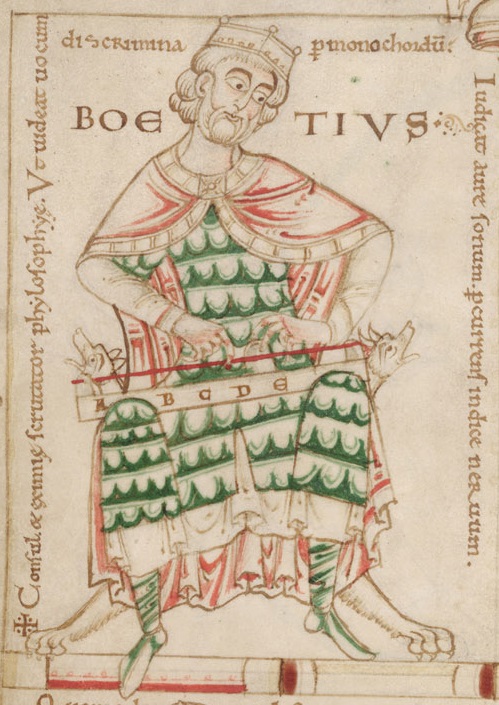
Anicius Manlius Severinus Boethius, also known as Boethius (; Latin: Boetius; c. 480–524 AD), held multiple prominent roles during the Early Middle Ages, including Roman senator, consul, magister officiorum, polymath, historian, and philosopher. His contributions were pivotal in translating Greek classics into Latin, establishing him as a precursor to the Scholastic movement and, alongside Cassiodorus, one of the foremost Christian scholars of the 6th century. The local veneration of Boethius within the Diocese of Pavia received official sanction from the Sacred Congregation of Rites in 1883, thereby affirming the diocese's established practice of commemorating him annually on October 23.
Born in Rome shortly after the compulsory abdication of Romulus Augustulus, the final Western Roman emperor, Boethius belonged to the Anicii family. Orphaned subsequent to his family's abrupt decline, he was subsequently fostered by Quintus Aurelius Memmius Symmachus, who later served as a consul. Having achieved proficiency in both Latin and Greek during his formative years, Boethius ascended to significant political influence within the Ostrogothic Kingdom, attaining the rank of senator by age 25, consul by age 33, and ultimately serving as a personal advisor to Theodoric the Great.
Driven by an ambition to synthesize the philosophies of Plato and Aristotle with Christian theological principles, Boethius embarked on a project to translate the complete corpus of Greek classics for Western intellectual audiences. His prolific output included numerous transcriptions and commentaries on the works of figures such as Nicomachus, Porphyry, and Cicero, in addition to extensive original writings on music, mathematics, and theology. Despite his premature demise leaving his translation efforts incomplete, his contributions were instrumental in preserving the works of Aristotle, ensuring their transmission into the Renaissance period.
Notwithstanding his achievements as a high-ranking official, Boethius incurred significant disfavor within the Ostrogothic court due to his vocal condemnation of widespread governmental corruption. Following his public defense of co-consul Caecina Albinus against accusations of conspiracy, he was incarcerated by Theodoric approximately in 523 AD. During his imprisonment, Boethius authored On the Consolation of Philosophy, a philosophical treatise exploring themes of fortune, mortality, and other existential concerns, which subsequently emerged as one of the most influential and extensively disseminated texts of the Early Middle Ages. His life concluded with torture and execution in 524 AD, leading to his traditional veneration as a martyr within the Christian faith.
Early life
Boethius was born into a patrician family in Rome around c. 480, though the precise date of his birth remains unrecorded. His natal family, the Anicii, constituted a remarkably affluent and influential gens, counting among its members emperors Petronius Maximus and Olybrius, alongside numerous consuls. Nevertheless, the family's prominence had significantly diminished in the period preceding Boethius's birth. Boethius's grandfather, also named Boethius and a senator, served as praetorian prefect of Italy but perished in 454 during the palace conspiracy targeting Flavius Aetius. His father, Manlius Boethius, who held the consulship in 487, passed away during Boethius's early childhood. Consequently, Quintus Aurelius Memmius Symmachus, a fellow patrician, adopted and reared him, thereby initiating his exposure to philosophy and literature. As an indication of their strong bond, Boethius subsequently married Rusticiana, his foster-father's daughter, and they had two sons, named Symmachus and Boethius.
Upon his adoption into the affluent Symmachi family, Boethius gained access to private tutors who facilitated his education during his formative years. While Symmachus possessed a degree of Greek fluency, Boethius attained complete mastery of the language—a proficiency that was becoming progressively uncommon in the Western Roman Empire—and committed his early professional life to translating the complete works of Plato and Aristotle. Notably, some of his translations represent the sole surviving Greek texts transmitted into the Middle Ages. Boethius's exceptional command of Greek has prompted scholarly speculation regarding an Eastern education; a long-held perspective, initially advanced by Edward Gibbon, posits that Boethius studied in Athens for eighteen years, drawing upon interpretations of Cassiodorus's correspondence, although this interpretation is now largely considered a potential misreading by earlier historians.
Historian Pierre Courcelle posits that Boethius pursued his studies in Alexandria under the tutelage of the Neoplatonist philosopher Ammonius Hermiae. Conversely, historian John Moorhead contends that the evidence supporting Boethius's Alexandrian education is "not as strong as it may appear," suggesting he could have attained his extensive knowledge without undertaking such travels. Regardless of his educational path, Boethius's proficiency in Greek proved instrumental throughout his life for translating classical Greek works, while his intellectual interests encompassed diverse fields including music, mathematics, astrology, and theology.
Rise to Power
Inspired by Plato's Republic, Boethius transitioned from his scholarly pursuits to commence his service under Theodoric the Great. Their initial encounter occurred in 500, when Theodoric visited Rome for a six-month stay. Although scant documentation details the early relationship between Theodoric and Boethius, it is evident that the Ostrogothic king regarded him favorably. Over the subsequent years, Boethius rapidly advanced through governmental ranks, achieving the position of senator by age 25 and consul by 510. His earliest recorded actions on behalf of the Ostrogothic ruler included investigating allegations that the paymaster of Theodoric's bodyguards had debased their wages, commissioning a waterclock for Theodoric to present to King Gundobad of the Burgundians, and securing the services of a lyre-player to perform for Clovis, King of the Franks.
In the Consolation, Boethius asserts that, despite his personal successes, he regarded his paramount accomplishment as the selection of both his sons by Theodoric to serve as consuls in 522, each representing the entirety of the Roman Empire. This appointment of his sons constituted an unprecedented distinction, not only because it underscored Theodoric's patronage for Boethius but also because the Byzantine emperor Justin I had ceded his own nomination as a gesture of goodwill, thereby endorsing Boethius's sons. In the same year as his sons' appointment, Boethius himself was elevated to the position of magister officiorum, assuming leadership over all government and palace affairs. Recounting the occasion, he wrote that he sat "between the two consuls as if it were a military triumph, [letting my] largesse fulfill the wildest expectations of the people packed in their seats around [me]."
Boethius's challenges emerged within a year of his appointment as magister officiorum: in his endeavor to rectify the pervasive corruption within the Roman Court, he recounts his efforts to counteract the machinations of Triguilla, the steward of the royal household; his confrontation with the Gothic minister, Cunigast, who sought to "devour the substance of the poor"; and his intervention, utilizing royal authority, to halt a food shipment from Campania that, if delivered, would have aggravated an ongoing famine in the region. These actions rendered Boethius an increasingly unpopular figure among court officials, though he retained Theodoric's favor.
Downfall and Death
In 520, Boethius engaged in efforts to restore amity between the Roman See and the Constantinopolitan See—though both ecclesiastical entities were then still part of the same Church, nascent disagreements had begun to surface between them. This initiative may have potentially initiated a sequence of events that would lead to his loss of royal favor. Five centuries later, these disagreements culminated in the East–West Schism of 1054, which ruptured communion between the Catholic Church and the Eastern Orthodox Church.
In 523, Boethius experienced a precipitous decline from power. After a period of imprisonment in Pavia for what was deemed a treasonable offense, he was executed in 524. Historical accounts largely concur regarding the facts of these events. At a meeting of the Royal Council convened in Verona, the referendarius, Cyprianus, accused the former consul Caecina Decius Faustus Albinus of treasonous correspondence with Justin I. Boethius leapt to his defense, vehemently declaring, "The charge of Cyprianus is false, but if Albinus did that, so also have I and the whole senate with one accord done it; it is false, my Lord King."
Cyprianus subsequently implicated Boethius in the identical offense, presenting three individuals who asserted they had witnessed the transgression. Boethius and Basilius were apprehended. Initially, the two were confined within a church's baptistery; subsequently, Boethius was banished to the remote rural property known as the Ager Calventianus, where he was ultimately executed. Shortly thereafter, Theodoric ordered the execution of Boethius's father-in-law, Symmachus, citing, according to Procopius, their alleged joint conspiracy to instigate a revolution, and subsequently confiscated their assets. Jeffrey Richards notes that "The fundamental facts of the case remain undisputed," adding that "What is contested regarding this sequence of events is their appropriate interpretation." Boethius contended that his offense involved seeking "the safety of the Senate." He characterized the three witnesses testifying against him as disreputable: Basilius had been discharged from royal service due to indebtedness, whereas Venantius Opilio and Gaudentius had been exiled for fraudulent activities. Conversely, other historical accounts portray these individuals in a considerably more favorable manner. Cassiodorus characterized Cyprianus and Opilio as "utterly scrupulous, just and loyal," further noting their familial relationship as brothers and grandsons of Consul Opilio.
Theodoric perceived a threat from prevailing international circumstances. The resolution of the Acacian schism prompted the Nicene Christian aristocracy within his dominion to endeavor to re-establish connections with Constantinople. Concurrently, the Catholic Hilderic ascended to the Vandalic throne, orchestrating the demise of Theodoric's sister, Amalafrida, while Arians in the East faced persecution. Furthermore, Boethius's prior associations with Theodahad seemingly positioned him unfavorably in the succession dispute that arose subsequent to the premature death of Eutharic, Theodoric's designated heir.
Historical sources present divergent accounts regarding the method of Boethius's execution. He might have been decapitated, bludgeoned to death, or subjected to hanging. It is plausible that he endured torture involving a rope tightened around his head, followed by bludgeoning until his eyes protruded, culminating in a fractured skull. Subsequent to an agonizing demise, his remains were interred within the church of San Pietro in Ciel d'Oro in Pavia, a site also serving as the sepulcher for Augustine of Hippo. His assets were seized, and his wife, Rusticiana, was consequently impoverished.
Historically, scholars have encountered difficulty reconciling the identity of a devout Christian with that of a profound Hellenist. These concerns primarily originate from the absence of any reference to Jesus or other Christian figures within Boethius's Consolation. Arnaldo Momigliano posits that "Boethius embraced paganism. His Christian faith disintegrated—it disintegrated so completely that he perhaps remained unaware of its vanishing." Conversely, numerous scholars adopt an alternative perspective, with Arthur Herman stating that Boethius was "unshakably Orthodox Catholic" and Thomas Hodgkin affirming that newly discovered manuscripts "unequivocally demonstrate Boethius's Christian identity." The intellectual milieu in which he participated accorded equal value to both classical and Christian cultural traditions.
Principal Works
De consolatione philosophiae
Boethius's most renowned composition is the Consolation of Philosophy (De consolatione philosophiae), penned during the final phase of his career while incarcerated and awaiting execution. This treatise presents an imagined discourse between Boethius and philosophy, personified as a female figure, asserting that, notwithstanding the world's ostensible inequities, a higher power exists in a Platonic sense, to which all other phenomena are subordinate under divine Providence.
Numerous manuscripts of this work have endured, undergoing extensive editing, translation, and printing across Europe from the late 15th century onward. Apart from the Consolation of Philosophy, his overarching life's endeavor constituted a deliberate effort to safeguard ancient classical knowledge, particularly within the domain of philosophy. Boethius harbored the ambition to translate the complete corpus of Aristotle's and Plato's writings from their original Greek into Latin.
De topicis differentiis
His comprehensive translations of Aristotle's logical treatises constituted the sole substantial segments of Aristotle's corpus accessible within Latin Christendom from the sixth century until the philosopher's broader rediscovery in the 12th century. Nevertheless, certain of his translations, including his exposition of the topoi in The Topics, incorporated his personal commentary, thereby integrating both Aristotelian and Platonic philosophical concepts.
The original commentaries are no longer extant. Beyond his commentary on the Topics, Boethius authored two significant treatises concerning topical argumentation: In Ciceronis Topica and De topicis differentiis. Comprising six books, the former treatise primarily serves as a critical engagement with Cicero's Topica. Book One of In Ciceronis Topica commences with a dedication addressed to Patricius. This work elucidates crucial philosophical distinctions and assertions central to Boethius's broader philosophical framework, including his perspective on philosophy's function as "establish[ing] our judgment concerning the governing of life," alongside definitions of logic derived from Plato, Aristotle, and Cicero. Boethius categorizes logic into three constituent elements: definition, division, and deduction.
Boethius posits three distinct categories of arguments: those based on necessity, those relying on ready believability, and those characterized by sophistry. Adhering to Aristotelian principles, he defines one class of Topic as the maximal proposition, which is a statement demonstrated to be either universal or readily credible. The second category of Topic, termed the *differentiae*, are described as "Topics that contain and include the maximal propositions," representing a method of classifying Topics that Boethius attributes to Cicero.
Book II addresses two categories of topics: those derived from related concepts and those originating from extrinsic sources. Book III explores the interrelationships between subjects examined via Topics, the Topics themselves, and the fundamental nature of definition. Book IV provides an analysis of partition, designation, and various relational structures between entities (e.g., pairing, enumeration, genus, and species). Following a comprehensive review of his terminology, Boethius dedicates Book V to an examination of Stoic logic and Aristotelian principles of causation. Book VI establishes a connection between the essence of the Topic and the concept of causes.
The treatise In Topicis Differentiis comprises four books. Book I examines the combined nature of rhetorical and dialectical Topics, with Boethius's overarching objective being "to show what the Topics are, what their differentiae are, and which are suited for what syllogisms." He differentiates between argument, defined as that which establishes belief, and argumentation, understood as that which provides a demonstration of belief. Propositions are categorized into three types: universal, particular, and intermediate. These and other distinctions are pertinent to both rhetorical and dialectical forms of topical argument. Books II and III predominantly address Topics within dialectic, specifically syllogisms, whereas Book IV focuses on the enthymeme, the fundamental unit of the rhetorical Topic. Topical argumentation forms the foundational element of Boethius's understanding of dialectic, which yields "categorical rather than conditional conclusions," and wherein he conceptualizes the identification of an argument as the discovery of a middle term capable of connecting the two terms of the intended conclusion.
These texts are not only of paramount importance for the study of Boethius but also critical to the historical development of topical theory. Boethius is largely credited with the revitalization of the Topics of Aristotle and Cicero. The Boethian tradition of topical argumentation exerted significant influence across the Middle Ages and into the early Renaissance, as evidenced by scholarly observations: "In the works of Ockham, Buridan, Albert of Saxony, and the Pseudo-Scotus, for instance, many of the rules of consequence bear a strong resemblance to or are simply identical with certain Boethian Topics ... Boethius's influence, direct and indirect, on this tradition is enormous."
Within De Topicis Differentiis, Boethius presented a distinctive contribution to the scholarly discourse on dialectic and rhetoric. Boethius's framework for topical argumentation introduces a novel categorization for the topics previously explored by Aristotle and Cicero. Notably, "[u]nlike Aristotle, Boethius recognizes two different types of Topics." He identifies the first type as a maximal proposition (maxima propositio), or fundamental principle. The second type, however, he designates as the differentia of a maximal proposition. Maximal propositions are characterized as "propositions [that are] known per se, and no proof can be found for these."
The concept of demonstration, or argument construction, fundamentally relies on self-evident truths or proofs that are so universally understood and integral to logical reasoning that they require no prior validation. These foundational propositions must inherently be true. As Stump explains, "the role of maximal propositions in argumentation is to ensure the truth of a conclusion by ensuring the truth of its premises either directly or indirectly." Such propositions are instrumental in formulating arguments via the Differentia, which constitutes the second element of Boethius' theoretical framework. This element represents "the genus of the intermediate in the argument." Thus, while maximal propositions establish a logical foundation for arguments, differentia are essential for their demonstration and construction.
Boethius defines "differentiae" as "the Topics of arguments," asserting that "The Topics which are the Differentiae of [maximal] propositions are more universal than those propositions, just as rationality is more universal than man." This definition represents the second distinct contribution of Boethius to rhetorical theory. Differentia function in conjunction with maximal propositions, serving "to be of use in finding maximal propositions as well as intermediate terms," which are the premises derived from maximal propositions.
Although Boethius draws inspiration from Aristotle's Topics, his Differentiae diverge in several respects. Boethius structures differentiae as individual statements, contrasting with Aristotle's method of organizing them into generalized categories. Stump clarifies this distinction, noting that Boethian differentiae are "expressed as words or phrases whose expansion into appropriate propositions is neither intended nor readily conceivable," unlike Aristotle's four distinct groups of Topics. While Aristotle cataloged hundreds of topics within these four groups, Boethius presented twenty-eight "Topics" that are "highly ordered among themselves." Recognizing this difference is crucial for understanding Boethius' unique position within the history of rhetorical theories.
Maximal propositions and Differentiae are relevant to both rhetoric and dialectic. Boethius elucidates dialectic by examining "thesis" and hypothetical propositions, stating: "[t]here are two kinds of questions. One is that called, 'thesis' by the [Greek] dialecticians. This is the kind of question which asks about and discusses things stripped of relation to other circumstances; it is the sort of question dialecticians most frequently dispute about—for example, 'Is pleasure the greatest good?' [or] 'Should one marry?'." Dialectic encompasses both "dialectical topics" and "dialectical-rhetorical topics," all of which are explored within De Topicis Differentiis. Specifically, dialectic, particularly in BookI, forms a significant part of Boethius' discourse on Topics.
Boethius intended to translate Plato's Dialogues in their entirety; however, no surviving translation is known, nor is it certain if the project was ever initiated.
De arithmetica
Boethius undertook the task of transmitting the rich Greco-Roman culture to subsequent generations by composing instructional manuals on subjects such as music, astronomy, geometry, and arithmetic.
Several of Boethius' works, which significantly influenced the Middle Ages, incorporated the philosophies of Porphyry and Iamblichus. Notably, Boethius authored a commentary on Porphyry's Isagoge, which brought to prominence the problem of universals: specifically, whether these concepts possess an independent existence irrespective of human thought, or if they exist solely as mental constructs. This inquiry into the ontological status of universal ideas became one of the most prominent philosophical controversies during the medieval period.
Beyond these advanced philosophical works, Boethius is also credited with translating significant Greek texts pertaining to the quadrivium. His adaptation of Nicomachus's treatise on arithmetic (De institutione arithmetica libri duo) and his textbook on music (De institutione musica libri quinque, an unfinished work) significantly influenced medieval curricula. De arithmetica commences with an exploration of modular arithmetic, encompassing concepts such as even and odd numbers, evenly even, evenly odd, and oddly even classifications. Subsequently, he delves into intricate numerical categorizations and the parts of numbers. His translations of Euclid on geometry and Ptolemy on astronomy, if ever completed, are no longer extant. Boethius produced Latin translations of Aristotle's De interpretatione and Categories, accompanied by commentaries. In his article The Ancient Classics in the Mediaeval Libraries, James Stuart Beddie attributes the widespread popularity of Aristotle's works in the Middle Ages to Boethius's efforts in preserving numerous texts by the philosopher.
De institutione musica
Boethius's De institutione musica, also known as De musica, stands as one of the earliest musical treatises to be printed in Venice between 1491 and 1492. Composed in the early sixth century, it facilitated the comprehension of ancient Greek music by medieval theorists from the ninth century onward. Echoing his Greek predecessors, Boethius posited that arithmetic and music were intrinsically linked, mutually enhancing comprehension and collectively illustrating the foundational principles of cosmic order and harmony as understood in his era.
In De Musica, Boethius introduced the threefold classification of music:
- Musica mundana – the music of the spheres or the cosmos; this 'music' was conceptual, not audibly perceived, and was meant for intellectual apprehension rather than sensory hearing.
- Musica humana – the harmony of the human body and spiritual equilibrium.
- Musica instrumentalis – instrumental music.
In De musica I.2, Boethius delineates 'musica instrumentis' as music generated by elements under tension (e.g., strings), by wind (e.g., aulos), by water, or through percussion (e.g., cymbals). Boethius himself did not employ the term 'instrumentalis,' which was later introduced by Adalbold II of Utrecht (975–1026) in his Epistola cum tractatu. This term gained significant prevalence from the 13th century onward. Furthermore, in these subsequent texts, musica instrumentalis became definitively linked with audible music broadly, encompassing vocal compositions. While scholars have conventionally presumed that Boethius similarly established this connection, potentially under the category of wind instruments ('administratur ... aut spiritu ut tibiis'), Boethius himself never explicitly differentiates 'instrumentalis' from 'instrumentis' within his concise account.
Within a section of his De institutione musica, Boethius asserted that "music is so naturally united with us that we cannot be free from it even if we so desired." Throughout the Middle Ages, Boethius's writings were associated with various texts employed in liberal arts instruction. Although he did not explicitly focus on the trivium as a subject, he authored numerous treatises elucidating the principles of rhetoric, grammar, and logic. His contributions to these disciplines were widely utilized during the medieval period for the study of the three elementary arts. Historian R. W. Southern famously characterized Boethius as "the schoolmaster of medieval Europe."
Oscar Paul's 1872 German translation of "De Musica" is considered his magnum opus.
Opuscula sacra
Boethius also authored Christian theological treatises, which upheld orthodox theology while condemning Arianism and other heterodox Christian doctrines.
Five theological works are known:
- De Trinitate – "The Trinity", in which he defends the Trinitarian position of the Council of Chalcedon, asserting that God exists in three persons who are consubstantial. He refutes the Arian perspective on the nature of God, a stance that conflicted with the beliefs of the Arian King of Italy.
- Utrum Pater et filius et Spiritus Sanctus de divinitate substantialiter praedicentur – "Whether Father, Son and Holy Spirit are Substantially Predicated of the Divinity", a concise treatise wherein he employs reason and Aristotelian epistemology to substantiate the correctness of Catholic doctrines concerning the nature of God.
- Quomodo substantiae, in which Boethius posits that all substances inherently possess goodness.
- De fide catholica, translated as "On the Catholic Faith."
- The treatise Contra Eutychen et Nestorium, meaning "Against Eutyches and Nestorius," composed around c. 513, represents Boethius's earliest theological contribution. This work addresses the divergent Christological doctrines of Eutyches and Nestorius, prominent figures of the early to mid-5th century, with Boethius advocating for a theological position consistent with Catholic doctrine.
Boethius's theological writings significantly influenced medieval philosophical discourse, particularly within the domains of logic, ontology, and metaphysics.
Dates of Works
Dates of Composition
Legacy
Edward Kennard Rand characterized Boethius as "the last of the Roman philosophers and the first of the scholastic theologians." Although his mathematical treatises were utilized in nascent universities, Boethius's enduring legacy, extending through the Middle Ages and beyond, was primarily established by his final work, The Consolation of Philosophy. This seminal text is structured as a dialogue between Boethius, initially expressing bitterness and despair during his incarceration, and the personified spirit of Philosophy, portrayed as a figure embodying wisdom and compassion. The Consolation, presented in alternating sections of prose and verse, advocates for the acceptance of adversity through a philosophical detachment from misfortune.
Elements of the work evoke the Socratic method found in Plato's dialogues, wherein the spirit of Philosophy interrogates Boethius and confronts his emotional responses to hardship. The text was notably translated into Old English by King Alfred, and subsequently into English by both Chaucer and Queen Elizabeth. Numerous manuscripts attest to its widespread influence, having been extensively edited, translated, and printed across Europe from the 14th century onward.
"The Boethian Wheel" conceptualizes Boethius's conviction that history operates as a cyclical process, a metaphor frequently employed in his Consolation. This concept maintained considerable popularity throughout the Middle Ages and continues to be referenced today. According to this model, the rotation of the wheel dictates that individuals possessing power and wealth will eventually decline, while others may ascend from destitution to prominence; conversely, those in positions of greatness may experience a reversal of fortune. This motif was widely depicted in medieval art, illustrating the vicissitudes of human existence. Literary references to "The Boethian Wheel" are prevalent in medieval texts, ranging from the Romance of the Rose to the works of Chaucer.
De topicis differentiis served as the foundational text for one of the earliest logical treatises composed in a Western European vernacular, specifically a collection of excerpts translated into Old French by John of Antioch in 1282.
Veneration
In the centuries following his death, Boethius was revered as a Christian martyr. Presently, he is formally recognized as a saint and martyr within the Christian tradition, and his name appears in the Roman Martyrology, although Watkins expresses reservations regarding "his status as martyr." His veneration is particularly observed in Pavia, where his sainthood was officially affirmed in 1883, and at the Church of Santa Maria in Portico in Rome. His feast day is commemorated on 23 October, a date sometimes cited as his death anniversary. Within the contemporary Martyrologium Romanum, his feast remains localized to that specific diocese. Pope Benedict XVI elucidated Boethius's contemporary significance for Christians by connecting his philosophical insights to the concept of Divine Providence.
In Popular Culture
Within Dante Alighieri's Divine Comedy, Saint Thomas Aquinas identifies the spirit of Boethius, who is subsequently referenced elsewhere in the epic poem.
In John Kennedy Toole's novel A Confederacy of Dunces, Boethius is presented as the preferred philosopher of the protagonist, Ignatius J. Reilly. The concept of "The Boethian Wheel" serves as a recurring thematic element throughout the book, which was awarded the Pulitzer Prize for Fiction in 1981.
C. S. Lewis makes reference to Boethius in chapter 27 of his work, The Screwtape Letters.
Boethius is also depicted in the 2002 film 24 Hour Party People, with Christopher Eccleston portraying the role.
A lunar crater was designated in honor of Boethius in 1976.
The title of Alain de Botton's book, The Consolations of Philosophy, originates from Boethius's Consolation.
A codex containing Boethius's The Consolation of Philosophy forms the central element of The Late Scholar, a Lord Peter Wimsey novel authored by Jill Paton Walsh.
- De Fide Catolica
- Prison literature
- Elpis (wife of Boethius)
Notes
References
Sources
- Books
- Journal articles
- Weblinks
Scholarly Publications
- Digital editions of Boethius's works are accessible via Standard Ebooks.
- Boethius's compositions are available through Project Gutenberg.
- The Internet Archive hosts a collection of works by and concerning Boethius.
- Public domain audiobooks of Boethius's writings are provided by LibriVox .
- De Trinitate (On the Holy Trinity), translated by Erik Kenyon.
- The Theological Tractates are available from the Christian Classics Ethereal Library.
- A tenth-century manuscript of Institutio Arithmetica is preserved at Lund University, Sweden.
- The 1885 edition of the Arithmetica, edited by Geoffrey Freudlin, is part of the Cornell Library Historical Mathematics Monographs.
- The University of Oklahoma Libraries' History of Science Collections include digitized galleries.
- Codices Boethiani: A Conspectus of Manuscripts of the Work of Boethius.
- The Perseus Digital Library contains works by Boethius.
- Manuscript 1083/30, containing the Regiment of Princes and Consolation of Philosophy, is accessible via OPenn.
- Manuscript 484/15, comprising Commentum super libro Porphyrii Isagoge and De decim predicamentis, is available through OPenn.
- The National Library of Portugal holds a 1499 Lyon edition of De Disciplina scholarium.
- A digitized twelfth-century manuscript of De Musica is housed at the Alexander Turnbull Library.
Information on Blessed Severinus Boethius is available in the Patron Saints Index.
- Blessed Severinus Boethius at Patron Saints Index
- Blackwood, Stephen. The Meters of Boethius: Rhythmic Therapy in the Consolation of Philosophy.
- Blackwood, Stephen (2015). The Consolation of Boethius as Poetic Liturgy. Oxford Early Christian Studies. Oxford University Press. p. 398. ISBN 978-0-19-871831-4.O'Connor, John J.; Robertson, Edmund F. "Boethius." MacTutor History of Mathematics Archive. University of St Andrews.Correia, Manuel. "Boethius." In Fieser, James; Dowden, Bradley (eds.). Internet Encyclopedia of Philosophy. ISSN 2161-0002. OCLC 37741658.
- Correia, Manuel. Fieser, James; Dowden, Bradley (eds.). "Boethius". Internet Encyclopedia of Philosophy. ISSN 2161-0002. OCLC 37741658.Marenbon, John. "Anicius Manlius Severinus Boethius." In Zalta, Edward N. (ed.). Stanford Encyclopedia of Philosophy. ISSN 1095-5054. OCLC 429049174.Source: TORIma Academy Archive