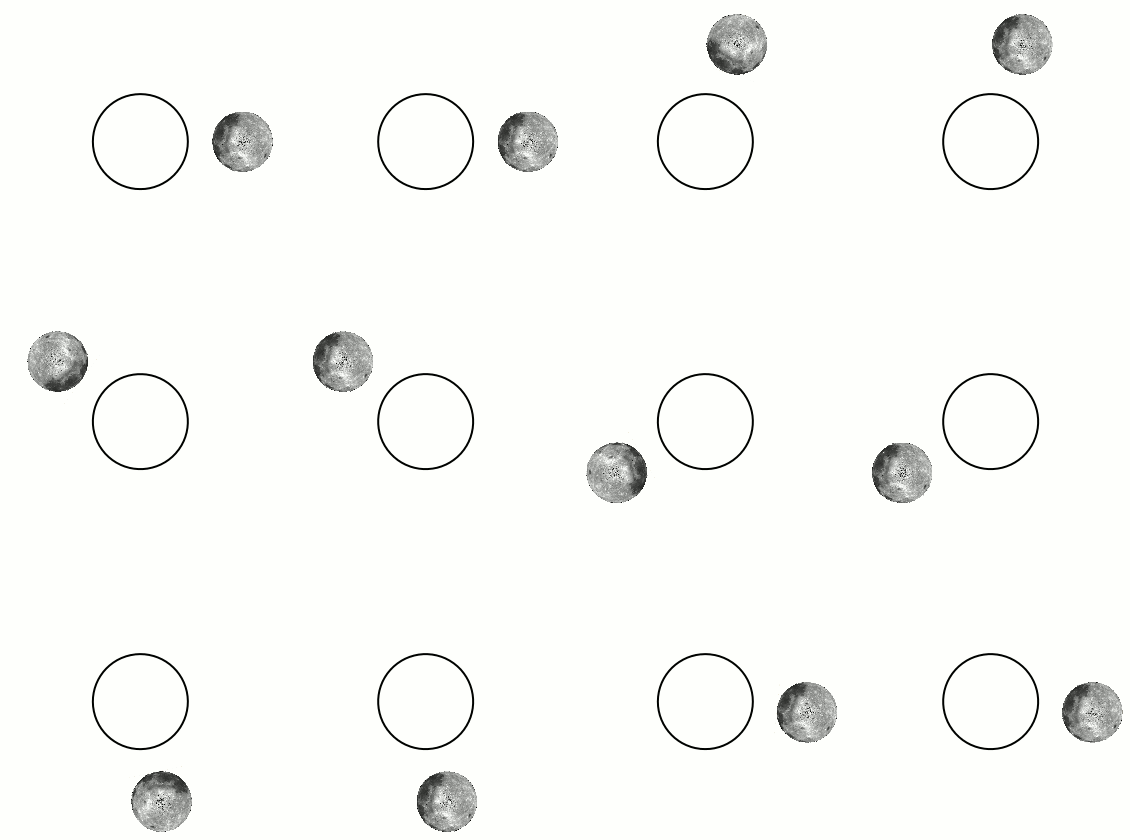
The phenomenon of tidal locking, observed between two co-orbiting astronomical entities, is characterized by one body achieving a rotational state where its spin rate exhibits no net alteration throughout a full orbital period. When a tidally locked body exhibits synchronous rotation, its axial rotation period precisely matches its orbital period around its companion. A prime illustration is the Moon, which consistently presents the same hemisphere to Earth, notwithstanding minor variations attributable to its non-perfectly circular orbit. Typically, only the satellite becomes tidally locked to its more massive primary. Nevertheless, in scenarios where the mass differential and the separation distance between two bodies are comparatively minimal, mutual tidal locking can occur, as exemplified by the Pluto–Charon and Eris–Dysnomia systems. Other designations for this process include gravitational locking, captured rotation, and spin–orbit locking.
This phenomenon originates from the gravitational interaction between two celestial bodies, which progressively decelerates one body's rotation until tidal locking is achieved. Over geological timescales, spanning millions of years, this interaction induces alterations in their orbital parameters and rotational velocities, driven by energy exchange and thermal dissipation. A body is formally considered tidally locked once it attains a state where its rotational rate exhibits no net variation throughout a complete orbital cycle. This state is inherently stable, as any deviation from it would necessitate the reintroduction of energy into the system. However, an object's orbit can evolve over extended periods, potentially disrupting the tidal lock, for instance, through gravitational perturbations from a massive planet.
The terminology 'tidally locked' and 'tidal locking' is subject to definitional ambiguity within scientific literature; some sources restrict its application solely to 1:1 synchronous rotation, as observed with the Moon, while others extend it to encompass non-synchronous orbital resonances where no net angular momentum transfer occurs over an orbital period. For instance, Mercury exhibits a 3:2 spin–orbit resonance, completing three rotations for every two revolutions around the Sun. Under specific conditions, such as a nearly circular orbit and an insignificant axial tilt (e.g., the Moon), tidal locking ensures that the same hemisphere of the orbiting body perpetually faces its companion. Irrespective of the adopted definition, the visible hemisphere of a tidally locked body undergoes minor variations over time, primarily due to fluctuations in its orbital velocity and the inclination of its rotational axis.
Mechanism
To elucidate the process, consider two co-orbiting celestial bodies, designated A and B. The requisite alteration in the rotational velocity for body B to become tidally locked with the more massive body A arises from the gravitational torque exerted by A on the tidal bulges it induces on B.
The gravitational force exerted by object A on object B is distance-dependent, peaking at the surface closest to A and diminishing at the most remote point. This differential gravitational pull establishes a gradient across body B, subtly deforming its hydrostatic equilibrium shape. Consequently, body B elongates along the axis pointing towards A, while simultaneously contracting slightly in dimensions orthogonal to this axis. These elongated deformations are termed tidal bulges. On Earth, for instance, these bulges can result in displacements of approximately 0.4 meters (1 foot 4 inches). Prior to tidal locking, these bulges migrate across B's surface as a consequence of orbital mechanics, with one of the two prominent tidal bulges typically positioned near the sub-A point. In the case of large astronomical bodies, whose shapes are predominantly spherical due to self-gravitation, tidal distortion manifests as a slightly prolate spheroid—an axially symmetric ellipsoid elongated along its major axis. Smaller bodies also undergo distortion, though their resulting shapes are less geometrically regular.
The constituent material of body B resists this cyclical reshaping induced by the tidal force. Consequently, a temporal delay exists in B's adjustment to its gravitational equilibrium shape, during which its rotation carries the developing bulges a certain distance away from the A–B axis. From an external perspective in space, the regions of maximal bulge extension appear offset from the axis directed towards A. Should B's rotational period be shorter than its orbital period, these bulges are displaced ahead of the A-oriented axis in the direction of rotation; conversely, if the rotational period is longer, the bulges trail behind.
As the bulges are now displaced from the A–B axis, the gravitational attraction from A on these displaced bulges generates a torque on B. The torque exerted on the bulge facing A endeavors to align B's rotational period with its orbital period. Conversely, the "back" bulge, oriented away from A, exerts a torque in the opposing direction. Nevertheless, the bulge positioned towards A is closer to A by approximately B's diameter than the rear bulge, consequently experiencing a marginally greater gravitational force and resultant torque. Therefore, the cumulative net torque from both bulges consistently operates to synchronize B's rotation with its orbital period, ultimately culminating in tidal locking.
Orbital Changes
Throughout this process, the total angular momentum of the A–B system remains conserved. Consequently, as body B decelerates and experiences a reduction in rotational angular momentum, its orbital angular momentum increases commensurately (minor effects on A's rotation also occur). This phenomenon leads to an elevation of B's orbit around A, concurrent with its rotational deceleration. Conversely, if B initially rotates too slowly, tidal locking simultaneously accelerates its rotation and lowers its orbital altitude.
Tidal Locking of the Larger Body
The larger body, A, also undergoes the tidal locking effect, albeit at a reduced rate, owing to the weaker gravitational influence of B, which stems from B's smaller mass. For instance, the Moon progressively decelerates Earth's rotation, a phenomenon discernible over geological timescales, as evidenced by the fossil record. Contemporary estimates suggest that this effect, combined with the Sun's tidal influence, has contributed to extending the Earth day from approximately 6 hours to its present 24 hours over a period of about 4.5 billion years. Presently, atomic clock measurements indicate that Earth's day extends by approximately 2.3 milliseconds per century, on average. Over a sufficiently long duration, this process would establish a state of mutual tidal locking between Earth and the Moon. Consequently, both the duration of Earth's day and the lunar month would lengthen. Ultimately, Earth's sidereal day would synchronize with the Moon's orbital period, which is approximately 47 times the current length of an Earth day. Nevertheless, Earth is not projected to achieve tidal locking with the Moon before the Sun evolves into a red giant and engulfs both celestial bodies.
In systems comprising bodies of comparable dimensions, the tidal effect can be of similar magnitude for both, potentially leading to mutual tidal locking on a significantly shorter timescale. A notable illustration is the dwarf planet Pluto and its satellite, Charon. These bodies have already attained a state where Charon is exclusively observable from a single hemisphere of Pluto, and conversely.
Eccentric Orbits
A common misconception posits that a tidally locked celestial body perpetually presents the same face to its host.
In orbits exhibiting non-negligible eccentricity, the rotational rate typically synchronizes with the orbital velocity when the body reaches periapsis, the point of maximal tidal interaction between the two celestial bodies. Should the orbiting object possess a companion, this third body can induce oscillatory variations in the parent object's rotation rate. Furthermore, this interaction can instigate an augmentation in the orbiting object's orbital eccentricity around the primary, a phenomenon termed eccentricity pumping.
Under conditions of eccentric orbits and comparatively weak tidal forces, the smaller body may achieve a state of spin–orbit resonance instead of full tidal locking. In such a resonance, the ratio of a body's rotational period to its orbital period is a simple fraction other than 1:1. A prominent example is Mercury's rotation, which is locked into a 3:2 resonance with its orbit around the Sun. This configuration causes its rotational speed to approximately match its orbital speed near perihelion.
Numerous exoplanets, particularly those in close proximity to their stars, are anticipated to exhibit spin–orbit resonances exceeding a 1:1 ratio. For instance, a terrestrial planet analogous to Mercury could become gravitationally captured into a 3:2, 2:1, or 5:2 spin–orbit resonance, with the likelihood of each outcome contingent upon its orbital eccentricity.
Occurrence
Moons
All twenty known spheroidal moons within the Solar System exhibit tidal locking with their primary bodies due to their close orbital proximity, which results in a rapid increase in tidal force, proportional to the inverse cube of the distance. Conversely, the majority of irregular outer satellites orbiting giant planets, such as Phoebe, do not display tidal locking, given their significantly greater orbital distances compared to the larger, well-established moons.
The Pluto-Charon system represents a notable instance of mutual tidal locking. Charon's substantial size relative to its primary, coupled with its exceptionally close orbit, contributes to this phenomenon, leading to a state of mutual tidal locking between Pluto and Charon. In contrast, Pluto's other satellites—Styx, Nix, Kerberos, and Hydra—do not exhibit tidal locking; instead, their rotations are chaotic, influenced by Charon's gravitational pull. A similar mutual tidal locking is observed between Eris and Dysnomia. While Orcus and Vanth may also be mutually tidally locked, current data remains inconclusive.
The prevalence of tidal locking among asteroid moons remains largely undetermined. Nevertheless, closely orbiting binary asteroids and contact binaries are theoretically anticipated to exhibit tidal locking.
Earth's Moon
The Earth's Moon exhibits synchronous rotation, meaning its rotational and orbital periods are tidally locked. Consequently, observers on Earth consistently view the same lunar hemisphere. The majority of the lunar far side remained unobserved until 1959, when the Soviet spacecraft Luna 3 successfully transmitted its initial photographs.
From the perspective of the Moon, Earth's apparent position in the sky remains largely static. It maintains an almost fixed location, presenting nearly its entire surface as it rotates on its own axis.
Although the Moon's rotational and orbital periods are precisely synchronized, approximately 59 percent of its total surface becomes visible from Earth through repeated observations, a phenomenon attributed to libration and parallax. Librations primarily arise from the Moon's fluctuating orbital velocity, a consequence of its eccentric orbit, enabling an additional approximately 6° of its perimeter to be observed from Earth. Parallax, a geometric effect, occurs because observers on Earth's surface are displaced from the direct line connecting the centers of Earth and the Moon; this displacement permits the observation of an additional approximately 1° of the lunar surface along its edges when comparing views during moonrise and moonset.
Planets
Historically, Mercury was believed to exhibit synchronous rotation with the Sun. This perception stemmed from observations consistently showing the same hemisphere facing inward during optimal viewing periods. However, radar observations in 1965 revealed that Mercury actually possesses a 3:2 spin–orbit resonance, completing three rotations for every two orbital revolutions around the Sun, thereby accounting for its consistent orientation during these observational windows. Furthermore, theoretical modeling indicates that Mercury achieved this 3:2 spin–orbit state very early in its history, likely within 10–20 million years following its accretion.
The 583.92-day synodic period between Venus's successive close approaches to Earth precisely corresponds to 5.001444 Venusian solar days, resulting in approximately the same Venusian hemisphere being presented towards Earth during each conjunction. The origin of this correlation, whether coincidental or indicative of a form of tidal locking with Earth, remains undetermined.
Proxima Centauri b, an exoplanet discovered in 2016 orbiting Proxima Centauri, is highly likely to be tidally locked, potentially exhibiting either synchronous rotation or a 3:2 spin–orbit resonance, analogous to Mercury.
A hypothetical category of tidally locked exoplanets includes 'eyeball planets,' which are further classified into 'hot' and 'cold' subtypes.
Stars
Throughout the cosmos, close binary star systems are anticipated to exhibit mutual tidal locking. Similarly, exoplanets discovered in extremely close orbits around their host stars are also presumed to be tidally locked to them. An atypical instance, corroborated by MOST observations, involves Tau Boötis, a star potentially tidally locked by its exoplanet, Tau Boötis b. Should this be the case, the tidal locking is almost certainly reciprocal.
Timescale
The estimated duration for a celestial body to achieve tidal locking can be calculated using the subsequent formula:
where
- represents the initial rotational velocity, quantified in radians per unit of time.
- denotes the semi-major axis of the satellite's orbital trajectory around the planet, calculated as the mean of its periapsis and apoapsis distances.
- represents the satellite's moment of inertia, where is the satellite's mass and is its average radius.
- signifies the satellite's dissipation function.
- denotes the universal gravitational constant.
- refers to the mass of the planet, which is the primary body being orbited, and
- is the satellite's tidal Love number.
The parameters and are generally poorly characterized, except for the Moon, which exhibits a value of . For a preliminary estimate, it is common practice to assume , which might be a conservative choice, potentially resulting in overestimated locking times.
where
- represents the density of the satellite
- denotes the surface gravity of the satellite
- represents the rigidity of the satellite. This value can be approximated as 3ק2021§§2425§ N/m§27
Despite knowing the satellite's size and density, numerous parameters still require estimation (specifically ω, Q, and μ); consequently, any derived locking times are anticipated to be inaccurate, potentially by an order of magnitude. Furthermore, during the tidal locking process, the semi-major axis might have diverged considerably from its current observed value due to subsequent tidal acceleration, and the locking time exhibits extreme sensitivity to this parameter.
Given the substantial uncertainty, the aforementioned formulas can be simplified into a more manageable expression. By assuming that the satellite is spherical, , and an initial non-locked rotational period of approximately 12 hours (most asteroids typically exhibit rotational periods between about 2 hours and 2 days),
Masses are expressed in kilograms, distances in meters, and in newtons per square meter. The value of can be approximated as 3ק3536§§3940§ N/m§42
The semi-major axis, denoted as , exerts a profoundly significant influence on this phenomenon.
In scenarios involving the tidal locking of a primary body to its satellite, such as the Pluto-Charon system, the parameters for the satellite and the primary body can be interchanged within the formula.
A significant implication derived from these principles is that, assuming all other factors remain constant (e.g., and ), a larger moon will achieve tidal lock more rapidly than a smaller moon orbiting at an equivalent distance from its planet. This occurs because the satellite's mass, , scales with the cube of its radius, . An illustrative instance of this phenomenon can be observed within the Saturnian system: Hyperion remains untidally locked, while the considerably larger Iapetus, despite orbiting at a greater distance, exhibits tidal locking. Nevertheless, this comparison is complicated by the fact that Hyperion is also subjected to substantial gravitational perturbations from the proximate moon Titan, which induces chaotic rotation.
The aforementioned formulae for calculating the tidal locking timescale may exhibit inaccuracies spanning several orders of magnitude, primarily due to their omission of the frequency dependence associated with . Furthermore, these models might not be applicable to viscous binary systems, such as binary stars or rubble-pile asteroids, where the spin–orbit dynamics are predominantly governed by their intrinsic viscosity rather than their rigidity.
Identified Tidally Locked Celestial Bodies
Within the Solar System
All celestial bodies listed subsequently are tidally locked; however, with the exception of Mercury, they also exhibit synchronous rotation. Mercury, while tidally locked, does not maintain synchronous rotation.
Exoplanetary Systems
- The predominant exoplanet detection methodologies, specifically transit photometry and radial velocity measurements, inherently possess an observational bias that favors the identification of planets in close proximity to their host stars. Consequently, 85% of discovered exoplanets reside within the tidal locking zone, which significantly impedes an accurate assessment of the true prevalence of this phenomenon. Notably, Tau Boötis is confirmed to be tidally locked with its closely orbiting giant planet, Tau Boötis b.
Celestial Bodies Potentially Tidally Locked
Solar System
A number of moons are hypothesized to be tidally locked, a conclusion drawn from comparing the estimated time required for a body to achieve tidal locking with the duration it has maintained its current orbit. For most planetary moons, this orbital duration is comparable to the age of the Solar System. However, definitive rotational data for these specific moons remains insufficient or unknown. These include:
Saturnian moons potentially tidally locked:
Uranian moons potentially tidally locked:
Neptunian moons potentially tidally locked:
Objects potentially mutually tidally locked:
- Orcus and Vanth
Extrasolar Systems
- The exoplanets Gliese 581c, Gliese 581b, and Gliese 581e are hypothesized to be tidally locked with their host star, Gliese 581.
- All planets within the TRAPPIST-1 system are considered probable candidates for tidal locking.
Angular momentum conservation refers to a conserved physical quantity, representing the rotational equivalent of linear momentum.Pages displaying brief descriptions of redirect targets
- Conservation of angular momentum – Conserved physical quantity; rotational analogue of linear momentumPages displaying short descriptions of redirect targets
- Gravity-gradient stabilization is a technique employed for the stabilization and orientation control of diverse spacecraft.
- The Kozai mechanism describes a phenomenon that influences the orbital dynamics of a binary system.
- Orbital resonance denotes the regular and periodic mutual gravitational interaction between orbiting celestial bodies.
- Planetary habitability refers to the established degree to which a planet possesses conditions suitable for supporting life.
- Pseudo-synchronous rotation describes a state of near synchronization between an object's revolution and rotation, particularly observed at periastron.
- The Roche limit defines the orbital radius within which a satellite is susceptible to disintegration due to the primary body's gravitational forces.
- A synchronous orbit is characterized by an astronomical body's orbital period being equivalent to its average rotational period.
- Tidal acceleration is a natural phenomenon that serves as the underlying cause of tidal locking.
- Rotation around a fixed axis describes a specific type of motion.