
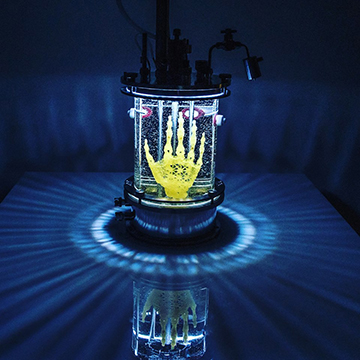
Bioart represents an artistic discipline that integrates biological elements, including live tissues, bacteria, living organisms, and fundamental life processes. Artworks within this field are created in laboratories, galleries, or artists' studios, employing scientific methodologies such as biology, life science practices, microscopy, and biotechnology, which encompasses techniques like genetic engineering, tissue culture, and cloning. The definitional scope of bioart remains a subject of discussion; some practitioners confine it strictly to "living forms," while others extend its purview to include art that utilizes imagery from contemporary medicine and biological research, or art that critically examines controversies or overlooked aspects inherent in the life sciences themselves.
Emerging at the confluence of the late 20th and early 21st centuries, bioart engages with living matter, prompting ongoing discourse regarding the precise criteria for defining "life" within artistic contexts. The creation of living entities and engagement with life sciences inherently provoke profound ethical, social, and aesthetic inquiries. Peter Weibel formally introduced and defined the term "bioart" in his 1981 essay, "Biotechnology and Art," characterizing it as an artistic movement that leverages biological systems as a primary medium for creative expression.
The development of living organisms and the exploration of biological sciences inherently raise significant ethical, social, and aesthetic considerations. Within the bioart discourse, a central debate revolves around whether the discipline encompasses all artistic engagement with biosciences and their societal ramifications—such as the use of medical imagery—or if it is exclusively limited to artworks produced directly within a laboratory setting.
Overview
Bioart frequently aims to illuminate themes and aesthetic qualities within biological subjects, critically examine philosophical concepts or scientific trajectories, and can occasionally evoke shock or humor. A review of the discipline in Isotope: A Journal of Literary Science and Nature Writing observes, "Bioart is often ludicrous. It can be lumpy, gross, unsanitary, sometimes invisible, and tricky to keep still on the auction block. But at the same time, it does something very traditional that art is supposed to do: draw attention to the beautiful and grotesque details of nature that we might otherwise never see." While prompting inquiries into science's societal role, these works predominantly engage in social commentary, articulating political and societal critiques through the synthesis of artistic and scientific methodologies. Although primarily viewed as contributions to the social, political, and economic dialogues stemming from scientific research, bioart occasionally also facilitates advancements in research itself.
Artists in laboratories
Although practitioners of bioart are primarily identified as artists within this emerging medium, they frequently also embody the role of scientists. Collaboration between artists and scientists is common in bioart, and in certain instances, artists themselves possess scientific backgrounds. While some artists enter the field with existing scientific training, others acquire the necessary procedural skills or collaborate closely with scientists capable of executing the required technical tasks.
Historical bioart
Historically, artists engaged critically with imagery derived from the life sciences, perceiving them not merely as illustrations of biological discoveries but as processes intrinsically linked to their contemporary period and stylistic conventions. Leonardo da Vinci, born in 1452 and celebrated for masterpieces such as the Mona Lisa and The Last Supper, exemplified a profound commitment to the convergence of science and art. To achieve precision and realism in his artistic creations, he undertook extensive, direct anatomical investigations, dissecting approximately 30 human cadavers, occasionally performing multiple dissections within a single day. Da Vinci's broader scientific endeavors, encompassing detailed studies of botany, optics, and light, were fundamentally motivated by his objective to elevate his artistic representations. His comprehensive exploration of human anatomy and locomotion notably foreshadowed modern robotics, as he established connections between anatomical understanding and engineering, designing automata that emulated human movement.
Ernst Haeckel, a prominent German biologist, zoologist, and artist active during the late 19th and early 20th centuries, employed artistic methods to illustrate his scientific discoveries prior to the advent of macrophotography and photographic microscopy. He meticulously documented the intricate details of natural forms through his vivid and distinctive drawings. His renowned 1904 publication, "Kunstformen Der Natur" (Artforms in Nature), continues to be recognized as a comprehensive visual encyclopedia of living organisms. Haeckel's interdisciplinary work, which integrated biology and art, not only advanced Darwinism within Germany but also profoundly impacted the fields of art, design, and architecture in the early 20th century.
Contemporary Bioart
The term 'transgenic art' was introduced in 1998 by Eduardo Kac, defining an artistic practice that utilizes genetic engineering techniques to introduce synthetic genes into an organism or to transfer natural genetic material between species, thereby generating novel living entities. Preceding this definition, Reiner Maria Matysik exhibited an art project titled Rekombination in 1986. The fundamental objective of transgenic art involves the creation of organisms harboring exogenous DNA. Kac posits that art possesses the capacity to extend evolutionary processes and facilitate the actual genesis of new life forms. Among Eduardo Kac's most recognized creations are Genesis (1998/99), The Eighth Day (2000/2001), and GFP Bunny (2000), the latter involving the commissioned creation of a transgenic GFP rabbit in 2000. The associated public relations campaign featured an image of Kac holding a white rabbit, alongside another rabbit digitally altered to display a green hue.
Symbiotica established one of the pioneering art/science laboratories, catering to artists engaged in bioart methodologies and technologies. Oron Catts and Ionat Zurr, co-founders of SymbioticA, also co-established The Tissue Culture & Art Project (TC&A). Since the early 1990s, TC&A has focused on the artificial cultivation of biological tissue, employing cell culture as an artistic medium. TC&A's projects explore various themes, including genetically modified foods, tissue-engineered clothing, sculptural forms derived from tissue culture, and the evolving relationship between living and non-living entities. Through their artistic investigations, these artists coined the term 'Semi-Living' to characterize a novel category of laboratory-generated life.
In 2003, The Tissue Culture & Art Project, in collaboration with Stelarc, developed a quarter-scale replica of an ear using human cells, culminating in the Extra Ear project. This endeavor was conducted at Symbiotica: the Art & Science Collaborative Research Laboratory, situated within the School of Anatomy and Human Biology at the University of Western Australia. In 2006, Stelarc underwent the first of two experimental surgical procedures to have his 'Ear On Arm' implanted. The subsequent surgery involved embedding a microphone within the implanted ear, enabling auditory perception. This implanted ear subsequently transmits sound globally, allowing individuals worldwide to access its auditory input. Stelarc has integrated the ear with the internet, thereby further merging his biological self with technology, while also introducing the potential for cyber vulnerability. The entire project spanned more than 12 years.
In 2004, Suzanne Anker and Dorothy Nelkin's publication, The Molecular Gaze, significantly contributed to the establishment of molecular biology's integration with artistic practice.
In 2009, Jalila Essaïdi's project Bulletproof Skin garnered global recognition for its integration of spider silk, sourced from genetically modified goats, into human skin tissue. This endeavor ignited discussions regarding potential military applications, specifically the creation of bullet-resistant skin, and significantly elevated the bioart movement's public profile through extensive international media coverage, including outlets like CNN, FOX, and the BBC. The project's impact prompted Essaïdi to establish the BioArt Laboratories foundation in Eindhoven, which subsequently achieved recognition as the national research institute for biological arts in the Netherlands. In collaboration with MU Hybrid Art House and ZonMw (the Netherlands Organisation for Health Research and Development), the foundation co-established the international Bio Art & Design Award, an initiative that has, for over a decade, cultivated partnerships between prominent research institutions and artists. Annually, three recipients were granted €25,000 each, totaling €75,000 per year, with cumulative awards exceeding €825,000 throughout the program's duration. Both the foundation and the award were instrumental in advancing the bioart movement by systematically connecting nascent artists with scientific laboratories and facilitating projects that later achieved international acclaim at prestigious venues such as the Centre Pompidou, the Venice Biennale, and the Museum of Modern Art.
Between 2015 and 2016, Amy Karle developed Regenerative Reliquary, a sculptural piece comprising bio-printed scaffolds designed for culturing human mesenchymal stem cells (MSCs) into bone, configured as a human hand and housed within a vessel. In 2019, Karle produced The Heart Of Evolution, a 3D-printed cardiac model incorporating a re-engineered vascular system intended to enhance cardiac function and potentially reduce the effects of embolism. Her 2024 creation, an interactive artwork titled Echoes From the Valley of Existence, involves the transmission of DNA samples, processed into powder and encapsulated in a polymer, into outer space.
Throughout the 2020s, bioart persists in its evolution, increasingly focusing on themes of environmental sustainability and social justice.
The intersection of art with biological and societal themes constitutes a significant area of inquiry within the field.
The precise scope of the term 'bioart' remains a subject of continuous academic discourse. A central point of contention revolves around whether bioart inherently necessitates the manipulation of biological materials, exemplified by microbial art, which is intrinsically composed of microorganisms. Conversely, a more expansive definition would encompass works that explore the social and ethical implications arising from the biological sciences. Within this broader framework, bioart as a genre frequently intersects with disciplines such as critical or speculative design. Such works typically engage a wider public audience, prioritizing the initiation of dialogue within this domain rather than the pioneering or direct application of specific biological methodologies. Illustrative examples include Ray Fish shoes, which marketed footwear crafted and patterned with genetically engineered stingray skin; BiteLabs, a biotechnology startup that endeavored to produce salami from cultured celebrity tissue samples; and Ken Rinaldo's Augmented Fish Reality, an installation featuring five mobile robotic fish-bowl sculptures guided by Siamese Fighting Fish.
The field of bioart is frequently associated with various controversies.
The creation of artworks utilizing living materials, developed through scientific processes and biotechnology, inherently raises numerous ethical questions and concerns. Wired magazine has highlighted that the "emerging field of 'bioart' can be extremely provocative, and brings with it a range of technical, logistical and ethical issues." While bioart practitioners occasionally contribute to the advancement of scientific research during their creative processes, the field and its artists can also generate controversy. This controversy may arise from challenging established scientific paradigms, employing contentious human or animal biological materials, or potentially releasing invasive species, particularly since bioartists are not consistently bound by regulatory standards such as biosafety or biosecurity protocols.
Another significant concern pertains to the hazards arising from errors and unconventional practices within unregulated or inadequately secure laboratory environments, including DIYbio, biohacking, and bioterrorism. A prominent example of a non-scientist's arrest on suspicion of "bioterrorism" involved artist Steve Kurtz, a co-founder of Critical Art Ensemble. Although arrested in 2004, no bioterrorism charges were ever filed against him. The FBI conducted a four-year investigation, which ultimately led to his indictment for mail and wire fraud, stemming from his acquisition of a bacterial strain commonly employed in educational laboratory settings. Kurtz intended to utilize this bacterium in an artistic project critical of the United States. His bioart contributions were recognized as groundbreaking in the fields of politically engaged art, biotechnology, and ecological advocacy. This protracted legal and artistic controversy subsequently became the subject of both a book and a film.
Bioart has faced considerable scrutiny and criticism, primarily due to concerns regarding a potential lack of ethical oversight. USA Today reported accusations from animal rights organizations, alleging that artists like Kac exploited animals for personal benefit. Additionally, conservative groups have expressed moral objections to the application of transgenic technologies and tissue-culturing practices.
Alka Chandna, a senior researcher at PETA in Norfolk, Virginia, asserted that the utilization of animals for artistic purposes is indistinguishable from their use for clothing materials. She further elaborated, stating: "Transgenic manipulation of animals is just a continuum of using animals for human end, regardless of whether it is done to make some sort of sociopolitical critique. The suffering and exacerbation of stress on the animals is very problematic."
Numerous bioart endeavors focus on the manipulation of cells rather than entire organisms, exemplified by Victimless Leather from the Tissue Culture & Art Project. The project's creators articulated their intent: "An actualized possibility of wearing 'leather' without killing an animal is offered as a starting point for cultural discussion. Our intention is not to provide yet another consumer product, but rather to raise questions about our exploitation of other living beings." Nevertheless, owing to rapid cellular proliferation, the exhibit was ultimately "deactivated" by nutrient deprivation, a method consistent with the artists' objective to underscore human responsibility toward manipulated biological forms.
Prominent Exhibitions of Bioart
Ars Electronica, located in Linz, Austria, and its associated festival, emerged as an early proponent of exhibiting and advancing bioart. It maintains its pioneering role in showcasing and fostering bioart, life projects, and bioartists. The long-established Prix Ars Electronica award, which recognizes and honors artists across diverse media, features categories such as hybrid arts and life art, both of which encompass bioart.
In 2016, the Beijing Media Art Biennale adopted "Ethics of Technology" as its central theme, followed by "<Post-Life>" in 2018. Hosted at the CAFA Museum in Beijing, China, the Biennale features significant works in biological arts through its thematic exhibitions. The 2018 iteration presented international artworks aligned with the thematic concepts of "Data Life," "Mechanical Life," and "Synthesized Life." Additionally, a dedicated Lab Space exhibition area highlighted international laboratory practices at the intersection of art and technology.
In 2019, the Centre Pompidou in Paris, France, hosted La Fabrique Du Vivant ('The Fabric of the Living'), a group exhibition showcasing recent works by artists, designers, and scientific researchers exploring living and artificial life. The exhibited artworks critically examined the interconnections between the biological and the artificial, encompassing processes of artificial life recreation, chemical manipulation of living matter, self-generating forms, hybridizations of organic and industrial materials, and the fusion of human and plant cells. Within the contemporary landscape of digital technologies, artists increasingly engage with biological concepts to construct novel social and political frameworks that address pertinent issues of the current epoch.
The Mori Art Museum in Tokyo, Japan, hosted "Future and the Arts: AI, Robotics, Cities, Life - How Humanity Will Live Tomorrow" from 2019 to 2020. This group exhibition featured a "bio atelier" showcasing bioartworks by leading international bioartists. A primary curatorial objective was to stimulate contemplation on the future of humanity, human life, and environmental challenges, particularly as shaped by advancements in artificial intelligence, biotechnology, robotics, and augmented reality, as applied in art, design, and architecture.
Gallery
- Computer art
- Digital art
- Electronic art
- Evolutionary art
- Hybrid arts
- Land art
- New Media art
References
Bibliography
- Anker, Suzanne, and Dorothy Nelkin. The Molecular Gaze: Art in the Genetic Age. Cold Spring Harbor, N.Y.: Cold Spring Harbor Laboratory Press, 2004. ISBN 978-087969-697-9.
- Bök, Christian. The Xenotext: Book I. Coach House Books, 2015.
- Da Costa, Beatriz, and Kavita Philip (eds.). Tactical Biopolitics: Art, Activism, and Technoscience. Cambridge: MIT Press, 2008.
- Gatti, Gianna Maria. The Technological Herbarium. Edited, translated from Italian, and with a preface by Alan N. Shapiro. Berlin: Avinus Press, 2010.
- Gessert, George. Green Light: Toward an Art of Evolution. Cambridge: MIT Press/Leonardo Books, 2010. ISBN 978-0-262-01414-4.
- Hauser, Jens. "Bio Art - Taxonomy of an Etymological Monster." UCLA Art/Sci Center series, 2006.
- Hauser, Jens (ed.). sk-interfaces. Exploding borders - creating membranes in art, technology and society. Liverpool: University of Liverpool Press, 2008. ISBN 978-1-84631-149-9.
- Kac, Eduardo. Telepresence and Bio Art. Ann Arbor: University of Michigan Press, 2005. ISBN 978-0-472-06810-4.
- Kac, Eduardo (ed.). Signs of Life: Bio Art and Beyond. Cambridge: MIT Press/Leonardo Books, 2007. ISBN 0-262-11293-0.
- Kaniarē, Asēmina, and Kathryn High. Institutional Critique to Hospitality: Bio Art Practice Now: A Critical Anthology. Grigoris publications, 2017. ISBN 9789606120190.
- Karafyllis, Nicole C. (ed.). Biofakte - Versuch über den Menschen zwischen Artefakt und Lebewesen. Paderborn: Mentis, 2003.
- Levy, Steven. "Best of Technology Writing 2007." Ann Arbor: University of Michigan Press, 2007 (in conjunction with DIGITALCULTUREBOOKS).
- Miah, Andy (ed.). Human Futures: Art in an Age of Uncertainty. Liverpool: Liverpool University Press, 2008. ISBN 978-1-84631-181-9.
- Mitchell, Rob. Bioart and the Vitality of Media. Seattle: University of Washington Press, 2010. ISBN 978-0-295-99008-8.
- Mitchell, Rob, Helen Burgess, and Phillip Thurtle. Biofutures: Owning Body Parts and Information. Pennsylvania: University of Pennsylvania Press, 2008. Interactive DVD.
- Reichle, Ingeborg. Kunst aus dem Labor. Springer, 2005. ISBN 978-3-211-22234-8.
- Sammartano, Paola. Electrophotographs and Photographs with Human Hair for Future Cloning. Sergio Valle Duarte Zoom Internacional, 1995.
- Savini, Mario. Arte transgenica: la vita è il medium. Connessioni. Pisa: Pisa University Press, 2018. ISBN 978-883339-0680.
- Schnugg, Claudia. Creating Artscience Collaboration: Bringing Value to Organizations. Cham, Switzerland. ISBN 978-3-030-04549-4. OCLC 108901485.
- Simou, Panagiota; Tiligadis, Konstantinos; Alexiou, Athanasios. Exploring Artificial Intelligence Utilizing Bioart. In: 9th Artificial Intelligence Applications and Innovations Conference, IFIP AICT 412, pp. 687–692. Springer, 2013.
- Thacker, Eugene. "Aesthetic Biology, Biological Art." Contextin' Art (Fall Issue, 2003).
- Thacker, Eugene. The Global Genome - Biotechnology, Politics, and Culture. Massachusetts: MIT Press/Leonardo Books, 2006. pp. 305–320. ISBN 978-0-262-70116-7.
- Vita-More, Natasha. "Brave BioArt 2: Shedding the Bio, Amassing the Nano, and Cultivating Emortal Life." Presented at the "Reviewing the Future" Summit, Coeur des Sciences, University of Quebec, Montreal, Canada, 2007. [5]
- Wilson, Stephen. "Art and Science Now: How Scientific Research and Technological Innovation are Becoming Key to 21st-Century Aesthetics." London: Thames and Hudson, 2012. ISBN 978-0-500-23868-4.
- Zylinska, Johanna. Bioethics in the Age of New Media. Cambridge: MIT Press/Leonardo Books, 2009. ISBN 978-0-262-24056-7.