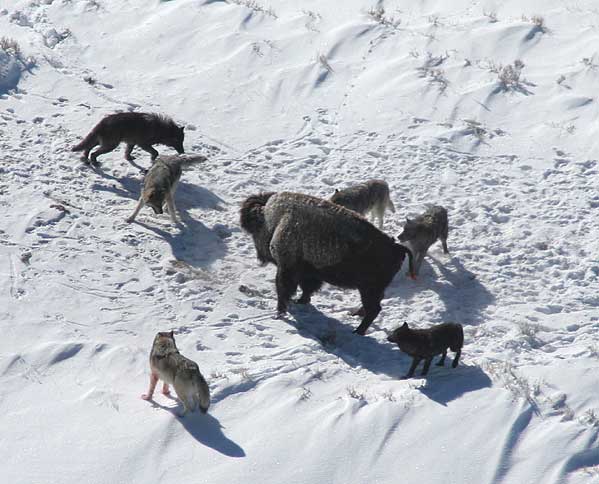
A pack constitutes a social aggregation of conspecific canines. The membership size and social dynamics of these groups exhibit interspecies variability. Within a pack, social structure holds paramount importance, with canine packs typically being led by a breeding pair.
Social Dynamics of Gray Wolf Packs
Cooperation is fundamental for critical activities like hunting and safeguarding offspring; however, the degree of individual attachment within a pack may not be uniform. Most wolves are observed to disperse from their natal packs, complicating the assessment of attachment behaviors. Instances exist where wolves depart their pack, often alongside same-sex siblings. This dispersal behavior is posited as adaptive, potentially conferring advantages to pack members in subsequent conflicts.
Membership in a wolf pack confers advantages to all individuals; weaker members receive support from stronger counterparts, while higher-ranking individuals gain access to superior and more substantial prey than they could acquire solitarily. Collective numbers provide enhanced protection, enabling the acquisition and maintenance of larger, more resource-rich territories. The responsibility for the care and protection of the young is shared, and knowledge is transmitted across generations, fostering a distinct culture within each group.
A wolf pack typically functions as a nuclear family unit, commonly comprising 5–10 individuals, though this number can extend to 30 in environments with abundant prey. These members are predominantly related, consisting specifically of a breeding pair (usually unrelated), their progeny, and occasionally a few other wolves, who may or may not be kin. Pack membership is often fluid and subject to alteration. External wolves may be ostracized or, less frequently, integrated, contingent upon specific situational factors. Given the interrelation within such groups, genetic variability can become restricted, necessitating conditions for gene flow. Dispersing wolves from other packs can facilitate this genetic exchange. A pack might admit an external wolf if it is a distant relative, if reproductive rates are diminished due to the absence or infertility of a dominant individual, or if the pack's overall numbers have significantly declined.
The categorization of wolves into dominance hierarchies, such as alpha, beta, and omega, originated from behavioral observations of unrelated captive wolves. This hierarchical framework is largely inapplicable to natural wolf packs, which are fundamentally familial units.
Solitary Wolves
These individual, unattached wolves, frequently termed "lone wolves," face heightened vulnerability to food scarcity and territorial aggression, typically constituting less than 15% of the overall wolf population. Lone wolf status commonly arises from sexually mature offspring dispersing from their natal pack, but it can also result from harassed subordinates choosing to leave. During periods of prey scarcity, lower-ranking wolves may opt for solitary existence if the pack cannot provide adequate sustenance. Subsequently, these lone wolves may endeavor to integrate into an established pack or, more frequently, locate a mate and initiate a new pack as the dominant breeding pair.
The Dominant Breeding Pair
Within a wolf pack, the breeding pair, or the dominant breeding pair in multi-breeder groups, commonly referred to colloquially as the "alpha pair" or "alpha wolves," are typically the family unit members responsible for reproduction and offspring production, serving as the matriarch and patriarch. Historically, it was presumed that an aging or infirm dominant individual would frequently be succeeded by one of their offspring; however, contemporary research indicates that such incestuous behavior is exceedingly uncommon.
Offspring Development
The significance of the dominant breeding pair is paralleled only by that of the pups. The primary objective of the pack is the successful propagation of offspring, rendering the rearing of a litter a cooperative endeavor wherein all members contribute to their development. During periods of resource scarcity, the breeding pair frequently prioritizes pup care, preferentially feeding the youngest wolves. Notwithstanding this dedicated involvement, pup mortality rates are substantial, with researchers reporting that approximately 30% survive their inaugural year. Nevertheless, surviving pups benefit from the presence of multiple caretakers and instructors. A distinct culture exists within wolf packs, transmitted to offspring by the group's elders. Pups acquire knowledge from each pack member, thereby developing essential social competencies crucial for forging the robust bonds underpinning wolf societal structure.
Social Dynamics in Other Canine Species
African wild dogs (Lycaon pictus) exhibit pack-based social structures for both habitation and hunting. Males contribute to pup rearing and remain with their natal pack throughout their lives. Conversely, females typically depart their birth pack around 2.5 years of age to integrate into a new pack devoid of other females. Within these packs, males generally outnumber females. These canids are not territorial and engage in cooperative hunting strategies. For instance, they collectively pursue large prey, which they then dismember as a group. Furthermore, they demonstrate cooperative care for injured, ill, and juvenile pack members.
Black-backed jackals (Canis mesomelas) in Southern and Eastern Africa, along with coyotes (Canis latrans) in North America, typically form monogamous, long-term pair bonds. Consequently, their hunting activities are usually solitary or conducted in pairs. A typical pack comprises the breeding pair and their current offspring. While they may occasionally form larger groups for hunting substantial prey, they seldom target animals exceeding the size of a small, young antelope. Black-backed jackals are generally not perceived as aggressive towards larger animals, though they exhibit caution around humans. Nevertheless, they will display aggression if their territorial boundaries are perceived as threatened.
Ethiopian wolves (Canis simensis) engage in solitary hunting for rodents; however, pack members primarily congregate for the collective defense of their territory against competing packs.
Bush dogs (Speothos venaticus) are considered the most social canid species in South America. While capable of solitary hunting, these animals typically inhabit small packs, which consist of a single breeding pair and their direct kin. Their home range spans approximately 3.8 to 10 square kilometers (1.5 to 3.9 sq mi). These packs are capable of subduing significantly larger prey, such as peccaries and rheas. Notably, a pack of six individuals was documented hunting a 250 kg (550 lb) tapir, employing a strategy of trailing the animal and biting its legs until it collapsed. During paca hunts, a portion of the pack pursues the prey on land, while others position themselves in water, anticipating the paca's frequent aquatic retreat.
Dholes (Cuon alpinus) organize into clans rather than conventional packs; however, these clans often subdivide into smaller hunting groups of three to five individuals, particularly during spring, a configuration deemed optimal for capturing fawns.
Unlike certain other fox species, Corsac foxes (Vulpes corsac) occasionally exhibit pack formation.
Dominance Hierarchies and the "Alpha Wolf" Concept
The term alpha is commonly used to denote individuals that typically exert dominance over others. Within wolf packs, the alpha wolves are generally the biological parents of the majority of the pack's offspring. This preferential access to breeding females establishes significant selective pressure for intrasexual competition.
Wolves demonstrate deference to the alpha pair within their pack, permitting them to regulate food distribution, often prioritizing the youngest members. Dominance and submission are communicated through eye contact and posture, primarily influenced by age; however, these displays are infrequent outside of contexts related to food, as previously noted. In smaller, more cohesive packs, alpha status is less frequently achieved through aggressive confrontation; instead, young wolves typically disperse to seek mates and establish their own progeny. Conversely, larger or less nuclear packs may exhibit distinct operational dynamics and possess more intricate and adaptable social structures.
Among other wild canid species, the alpha male may not possess exclusive mating rights with the alpha female. Furthermore, other pack members might participate in guarding the maternity den utilized by the alpha female, a behavior observed in species such as the African wild dog (Lycaon pictus).
Given that dominant roles are considered typical among social species exhibiting extended parental care, it has been proposed that the term alpha is superfluous for merely describing ubiquitous dominance. Instead, its application should be restricted to instances where the individual is the primary progenitor of the pack. For example, wolf biologist L. David Mech articulated:
The designation of a wolf as an alpha is generally considered as inappropriate as labeling a human parent or a doe deer with the same term, alpha. Since any parent naturally dominates its young offspring, the term alpha conveys no additional information. Alternative, more informative designations for an alpha female could include the female parent, the breeding female, the matriarch, or simply the mother. These terms highlight the animal's crucial role as a pack progenitor, rather than its trivially dominant status. The term alpha might still be applicable in the limited instances of large wolf packs containing multiple litters. In these specific scenarios, the older breeding individuals, who likely dominate the younger breeders, could potentially be more accurately referred to as the alphas. The primary concern is not merely the terminology itself, but the misleading implication of a rigid, force-based dominance hierarchy that this terminology often conveys.
The concept of the alpha wolf emerged from studies of captive wolf packs composed of unrelated individuals. In contrast, wild wolf packs are typically family units, where the dominant breeding pair consists of the parents of the other pack members. Consequently, conflicts over dominant status are considerably less frequent in wild wolf populations than initially presumed. Contemporary biologists now regard alpha wolf as an obsolete term and refrain from employing it.
Application in Canine Training
A highly enduring yet contentious theory within canine training literature posits the existence of the alpha wolf, a gray wolf individual that asserts dominance within its pack through body language and, when necessary, physical force. This concept initially appeared in early wolf research and was subsequently integrated into dog training methodologies. However, subsequent research has challenged this theory, highlighting its foundation in observations of captive packs comprising unrelated individuals, whereas natural wolf packs are typically composed of family members.
The term alpha gained widespread recognition as early as 1976 through the canine training manual How to Be Your Dog's Best Friend by the Monks of New Skete, which introduced the concept of the alpha roll as a method for correcting undesirable canine behaviors. In his 2001 publication How to Speak Dog, psychologist and dog trainer Stanley Coren asserted, "You are the alpha dog... You must communicate that you are the pack leader and dominant."
It has been proposed that the application of these techniques might be more reflective of human psychology than actual canine behavior. While "dominance hierarchies and dominance disputes and testing are a fundamental characteristic of all social groups," it is suggested that "perhaps only we humans learn to use punishment primarily to gain for ourselves the reward of being dominant."
The majority of prominent veterinary and animal behavior associations, alongside most contemporary trainers, endorse the utilization of rewards for teaching commands and fostering effective communication between pet owners and their animals. Numerous modern practices advocate for discontinuing obsolete "pack" methodologies. Certain canine behaviorists propose that humane and effective training incorporates games to impart commands, which can then be applied to enhance an owner's daily life.
Pack Hunter
- Pack hunter
- Canine Behavior