
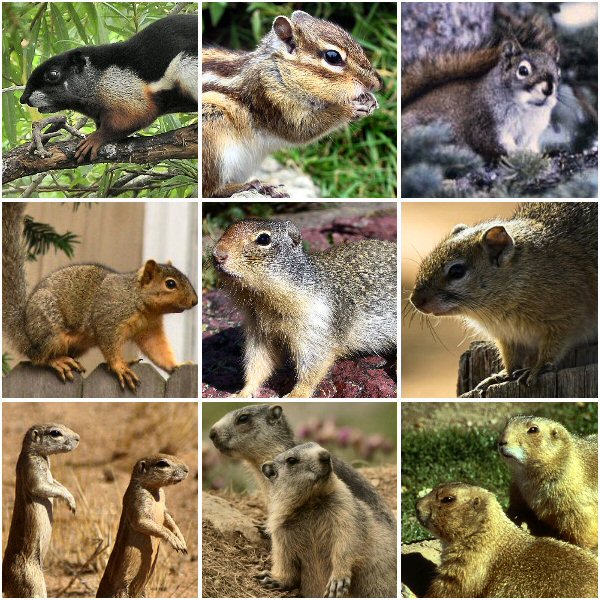
Squirrels, phonetically represented as /ˈskwɜːr.əl(z)/ or SKWUR-əl(z), belong to the family Sciuridae ( sih-YOO-rih-day, -dee), which encompasses small to medium-sized rodents. This family comprises various subgroups, including tree squirrels, ground squirrels (such as chipmunks and prairie dogs), and flying squirrels. Their native range spans the Americas, Eurasia, and Africa, with human introductions establishing populations in Australia. Fossil evidence indicates the earliest known squirrels emerged during the Eocene epoch, and phylogenetic analyses suggest their closest living relatives among rodents are the mountain beaver and dormice.
Squirrels (/ˈskwɜːr.əl(z)/ SKWUR-əl(z)) are members of the family Sciuridae ( sih-YOO-rih-day, -dee), a family that includes small or medium-sized rodents. The squirrel family includes tree squirrels, ground squirrels (including chipmunks and prairie dogs, among others), and flying squirrels. Squirrels are indigenous to the Americas, Eurasia, and Africa, and were introduced by humans to Australia. The earliest known fossilized squirrels date from the Eocene epoch, and among other living rodent families, the squirrels are most closely related to the mountain beaver and dormice.
Etymology
The term squirrel, documented since 1327, originates from the Anglo-Norman esquirel, which itself derives from the Old French escureil. This Old French term is a derivative of the Latin word sciurus, which was adopted from the Ancient Greek σκίουρος (skiouros). This Greek compound word combines σκιᾱ́ ('shade') and οὐρᾱ́ ('tail'), referencing the characteristic long, bushy tail possessed by many species within the family. Notably, Sciurus also designates one of the genera within this family.
The Old English designation for the squirrel, ācweorna, persisted into Middle English as aquerne prior to its eventual obsolescence. This Old English term shares a Common Germanic etymology, with cognates still prevalent in other Germanic languages, such as the German Eichhörnchen (a diminutive of the less common Eichhorn); the Norwegian ikorn/ekorn; the Dutch eekhoorn; the Swedish ekorre; and the Danish egern.
Collectively, a group of squirrels is referred to as a "dray" or a "scurry".
Characteristics
Squirrels typically exhibit a small stature, with sizes varying significantly across species; for instance, the African pygmy squirrel and least pygmy squirrel measure 10–14 cm (3.9–5.5 in) in total length and weigh merely 12–26 g (0.42–0.92 oz). In contrast, the Bhutan giant flying squirrel can reach up to 1.27 m (4 ft 2 in) in total length, and certain marmot species may exceed 8 kg (18 lb). Characteristically, squirrels possess slender physiques, complemented by long, bushy tails and prominent eyes. Their pelage is generally soft and silky, although its density varies considerably among species. Coat coloration in squirrels demonstrates substantial variability both inter- and intra-specifically.
The majority of squirrel species exhibit hind limbs that are proportionally longer than their forelimbs, and all species possess either four or five digits on each foot. Their feet, featuring an often vestigial thumb, are equipped with soft plantar pads and robust, versatile claws, facilitating effective grasping and arboreal locomotion. Uniquely among most mammals, tree squirrels are capable of descending trees headfirst. This feat is accomplished by rotating their ankles 180 degrees, which allows their hind feet to orient backward, thereby providing a secure grip on the tree bark from an inverted position.
Head
The prominent size of their eyes suggests acute vision, a crucial adaptation particularly for arboreal species. Furthermore, many species exhibit a well-developed sense of touch, evidenced by the presence of vibrissae on both their limbs and heads.
The dentition of sciurids conforms to the characteristic rodent pattern, featuring prominent incisors adapted for gnawing that exhibit continuous growth throughout the animal's lifespan. Posterior to a broad diastema, or gap, are the cheek teeth, specialized for grinding. The standard dental formula for sciurids is 1.0.1.31.0.1.3.
Tail
The caudal appendage of squirrels serves multiple functions, including:
- Providing protection from precipitation, wind, or cold.
- Facilitating thermoregulation by increasing blood flow to the tail during periods of elevated temperature.
- Acting as a counterbalance during arboreal locomotion and leaping.
- Functioning as a rudimentary parachute during descents or falls.
- Serving as a visual signaling device.
The fine hairs from squirrel tails are highly valued in the craft of tying fishing flies, owing to their superior quality for this application.
When a squirrel adopts an upright posture, its tail, folded along its back, may obscure its characteristic small mammal silhouette, potentially deterring predators approaching from the rear.
Lifetime
Squirrels inhabit nearly all terrestrial environments, ranging from tropical rainforests to semiarid deserts, with the notable exceptions of extreme polar regions and the most arid deserts. While primarily herbivorous, consuming seeds and nuts, many species also supplement their diet with insects and occasionally small vertebrates.
A significant proportion of juvenile squirrels succumb during their initial year of life. Adults typically exhibit a lifespan ranging from 5 to 10 years in natural habitats, while in captive environments, some individuals may persist for 10 to 20 years. Premature mortality can result from nest dislodgement, potentially leading to maternal abandonment if the offspring's body temperature is compromised. While numerous infant squirrels have been rescued and rehabilitated for eventual reintroduction into the wild, the high population density in many areas and the intensive care demands of premature squirrels often deter rehabilitators, leading to the routine euthanasia of such animals.
Behavior
Squirrels engage in mating either annually or biannually, producing a species-variable number of offspring after a gestation period of three to six weeks. Neonates are altricial, characterized by their naked, edentulous, and anophthalmic state at birth. Typically, the female parent provides sole care for the young, which are weaned between six and ten weeks of age and attain sexual maturity by the conclusion of their first year. Generally, terrestrial squirrel species exhibit social behaviors, frequently forming intricate colonies, whereas arboreal species tend to be more solitary.
Terrestrial and arboreal squirrel species typically display diurnal or crepuscular activity patterns, whereas flying squirrels are predominantly nocturnal, with the exception of lactating females and their offspring, who exhibit a period of diurnality during the summer months.
In periods of elevated temperatures, squirrels have been observed to engage in "splooting," a behavior involving lying prone with their ventral side against cool surfaces.
Similar to other rodent species, squirrels utilize distinct, species-specific food storage strategies to mitigate periods of resource scarcity. In temperate zones, squirrels frequently cache nuts beneath leaf litter, within arboreal cavities, or subterraneously. Conversely, in subtropical and humid climates, conventional caching methods can result in fungal proliferation, decomposition, or premature germination of stored items. To mitigate these issues, certain squirrel species, particularly those inhabiting subtropical regions, suspend nuts or fungi from tree branches. This practice is hypothesized to reduce fungal contamination and minimize food loss, while also inadvertently facilitating the range expansion of specific tree species, such as Cyclobalanopsis, through the germination of forgotten or dislodged nuts in novel locations, thereby impacting forest ecology. Two flying squirrel species, the particolored flying squirrel and the Hainan flying squirrel, enhance this caching method by incising grooves into nuts, allowing them to be securely wedged between small intersecting twigs, a technique reminiscent of a mortise-tenon joint in woodworking.
Feeding
Due to their inability to digest cellulose, squirrels necessitate a diet abundant in proteins, carbohydrates, and fats. For squirrels in temperate zones, early spring represents a period of significant challenge, as cached nuts begin to germinate, rendering them inedible, and many typical food sources remain unavailable. Consequently, during such periods, squirrels predominantly subsist on tree buds. As primarily herbivorous animals, squirrels consume a diverse range of plant matter, including nuts, seeds, conifer cones, fruits, fungi, and green foliage. Nevertheless, certain squirrel species also incorporate meat into their diet, particularly during periods of food scarcity. Observations have documented squirrels preying on small birds, juvenile snakes, smaller rodents, avian eggs, and insects. Certain tropical squirrel species have undergone an almost complete dietary shift towards insectivory.
Squirrels, alongside species such as pigeons and feral cats, are classified as synanthropes, indicating their capacity to benefit and proliferate within human-modified environments. This incremental process of successful adaptation is termed synurbanization, characterized by the diminution of squirrels' innate fear of humans within urban settings. Following their near eradication during the Industrial Revolution in New York, squirrels were subsequently reintroduced to serve as a source of entertainment and a natural reminder for human inhabitants. Their integration into urban environments has been so effective that a cessation of synanthropic behaviors (e.g., the absence of discarded food during severe winters) can lead to increased aggression in their foraging efforts.
Predatory and aggressive behaviors have been documented in various ground squirrel species, particularly the thirteen-lined ground squirrel. For instance, in the 1920s, scientist Bernard Bailey observed a thirteen-lined ground squirrel preying on a young chicken. Wistrand also reported witnessing this species consuming a freshly killed snake. Occasionally, squirrels may prey on unusual animals; in 2005, a group of black squirrels in Lazo, Russia, reportedly killed and consumed a large stray dog. Attacks by squirrels on humans are exceptionally uncommon.
Whitaker's examination of 139 thirteen-lined ground squirrel stomachs revealed bird flesh in four specimens and short-tailed shrew remains in one. Similarly, Bradley's analysis of 609 white-tailed antelope squirrel stomachs indicated that at least 10% contained some form of vertebrate, predominantly lizards and rodents. Morgart further documented a white-tailed antelope squirrel capturing and consuming a silky pocket mouse.
Taxonomy
Extant squirrel species are categorized into five subfamilies, encompassing approximately 58 genera and 285 species. The earliest known squirrel fossil, Hesperopetes, originates from the Chadronian period (late Eocene, approximately 40–35 million years ago) and exhibits resemblances to contemporary flying squirrels.
Numerous fossil squirrel specimens, spanning from the late Eocene to the Miocene epochs, remain unassigned with certainty to any extant lineage. It is probable that some of these represent variations of the earliest basal "protosquirrels," characterized by the absence of the complete set of autapomorphies found in living squirrels. The geographical distribution and evolutionary diversity of these ancient and ancestral forms imply a potential North American origin for the squirrel group.
Beyond these occasionally obscure fossil forms, the phylogenetic relationships of extant squirrels are relatively clear. The three primary lineages include the Ratufinae (Oriental giant squirrels), Sciurillinae, and all other subfamilies. The Ratufinae comprise only a few living species found in tropical Asia. The neotropical pygmy squirrel, endemic to tropical South America, represents the sole extant member of the Sciurillinae. The third lineage, which is considerably the largest, exhibits a nearly cosmopolitan distribution. This evidence reinforces the hypothesis that the common ancestor of all squirrels, both living and fossil, originated in North America, given that these three most ancient lineages appear to have diversified from that region. Conversely, if squirrels had originated in Eurasia, one would anticipate the presence of very ancient lineages in Africa, yet African squirrels appear to be of more recent evolutionary derivation.
The primary squirrel group is divisible into five subfamilies: Callosciurinae, comprising 60 species predominantly located in Southeast Asia; Ratufinae, consisting of 4 cat-sized species inhabiting South and Southeast Asia; Sciurinae, which encompasses the flying squirrels (Pteromyini) and tree squirrels, totaling 83 species distributed globally; Sciurillinae, represented by a single South American species; and Xerinae, which includes three tribes of primarily terrestrial squirrels: Marmotini (marmots, chipmunks, prairie dogs, and other Holarctic ground squirrels), Xerini (African and some Eurasian ground squirrels), and Protoxerini (African tree squirrels).
Taxonomic List
- Basal and incertae sedis Sciuridae (exclusively fossil forms)
- Hesperopetes
- Kherem
- Lagrivea
- Oligosciurus
- Plesiosciurus
- Prospermophilus
- Sciurion
- Similisciurus
- Sinotamias
- Vulcanisciurus
- Subfamily Cedromurinae (fossil)
- Subfamily Ratufinae – Oriental giant squirrels (1 genus, 4 species)
- Subfamily Sciurillinae – Neotropical pygmy squirrel (monotypic)
- Subfamily Sciurinae
- Tribe Sciurini – Tree squirrels (5 genera, approximately 38 species)
- Tribe Pteromyini – True flying squirrels (15 genera, approximately 45 species)
- Subfamily Callosciurinae – Asian ornate squirrels
- Tribe Callosciurini (13 genera, nearly 60 species)
- Tribe Funambulini – Palm squirrels (1 genus, 5 species)
- Subfamily Xerinae – Terrestrial squirrels
- Tribe Xerini – Spiny squirrels (3 genera, 6 species)
- Tribe Protoxerini (6 genera, approximately 50 species)
- Tribe Marmotini – Ground squirrels, marmots, chipmunks, prairie dogs, and related species (6 genera, approximately 90 species)
Relationship with Humans
List of animal names: Squirrel
- List of animal names#squirrel
- Variant Creutzfeldt–Jakob disease (Kuru) linked to the consumption of squirrel brains.
References
References
- Whitaker, John O. Jr., and Robert Elman. (1980). The Audubon Society Field Guide to North American Mammals (2nd ed.). New York: Alfred A. Knopf, Jr. ISBN 0-394-50762-2.Milton, Katherine. (1984). "Family Sciuridae." In D. Macdonald (ed.), The Encyclopedia of Mammals: 612–623. New York: Facts on File. ISBN 0-87196-871-1.
- Milton, Katherine (1984): "Family Sciuridae". In: Macdonald, D. (ed.): The Encyclopedia of Mammals: 612–623. Facts on File, New York. ISBN 0-87196-871-1.
- Steppan, Scott J., and Shawn M. Hamm. (2006). "Sciuridae (Squirrels)." *Tree of Life Web Project*. Version published May 13, 2006. Accessed December 10, 2007.
- Steppan, S. J., B. L. Storz, and R. S. Hoffmann. (2004). "Nuclear DNA phylogeny of the squirrels (Mammalia: Rodentia) and the evolution of arboreality from c-myc and RAG1." Molecular Phylogenetics and Evolution. 30 (3): 703–719. Bibcode:2004MolPE..30..703S. doi:10.1016/S1055-7903(03)00204-5. PMID 15012949.Mammal Species of the World: A Taxonomic and Geographic Reference: 754–818. Baltimore: Johns Hopkins University Press.
- Quotations related to Squirrel at Wikiquote
- Squirrel Tracks: How to identify squirrel tracks in the wild
- List of names of squirrel taxa