
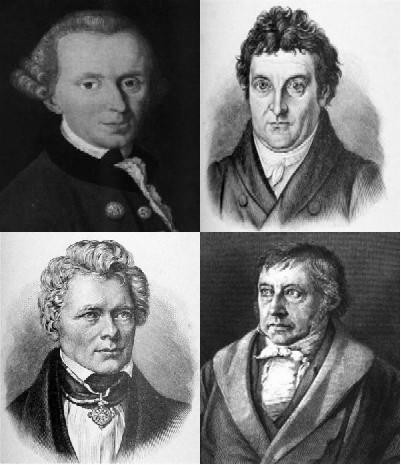
German idealism is a philosophical movement that originated in Germany during the late 18th and early 19th centuries. It stemmed from the philosophical contributions of Immanuel Kant in the 1780s and 1790s, and was intricately connected to both Romanticism and the revolutionary political thought of the Enlightenment era. This post-Kantian phase of German idealism is additionally referred to as post-Kantian idealism or simply post-Kantianism. A common categorization distinguishes German idealists as transcendental idealists, exemplified by Kant and Fichte, and absolute idealists, identified with Schelling and Hegel.
The Concept of Idealism
Philosophically, idealism posits that the fundamental objects of knowledge are "ideal," signifying their dependence on the mind, in contrast to material existence. This terminology originates from Plato's assertion that the "Ideas"—categories or concepts abstracted by the mind from empirical experiences of specific entities—possess a greater reality than the particulars themselves, which are contingent upon these Ideas rather than vice versa. Within the framework of German idealism, however, this term carries ambiguity due to its varied application by Kant and his subsequent thinkers, notably Fichte, Schelling, and Hegel.
According to Kant, human cognition of external reality must align with the structure imposed upon our experience of this reality by our own minds during the reception of information or stimuli (e.g., sensory data). When abstracting from specific instances—for instance, to identify underlying physical forces or logical principles essential for coherent speech and thought—we are merely "uncovering" the categorical or conceptual framework that our own mind inherently contributes to all our experiences. Unlike Plato's assertion, we do not directly apprehend the intrinsic structure of external reality; it remains perpetually beyond our grasp.
Consequently, Kant's idealism is characterized as "transcendental" or "critical," as it investigates the categorical (transcendental) architecture of potential knowledge, thereby tracing all epistemic assertions to their origins within the subject's inherent categorical framework. For instance, Kant contends that teleological interpretations of phenomena like homeostasis and autopoiesis in organisms, despite appearing observable and thus empirically verifiable (or at least probable), arise from our subjective constitution projecting specific concepts onto organized matter. Conversely, Kant applies the same critical argument to materialist reductionism, asserting that it too functions as an outcome of particular "regulative" ideals (e.g., the impulse to simplify our perception of external plurality and multiplicity into a minimal set of fundamental laws, forces, and entities). From the perspective of the critical idealist, it is fundamentally impossible to know whether living organisms are ultimately teleological, mechanical, or possess an entirely different nature.
Kant's intellectual successors concurred with his assertion that the subject, in its ordinary state, lacks direct apprehension of external reality (as posited by naive realism), and that empirical knowledge derived from sensory data ultimately reveals only the subject's own categorical structuring of this information. However, they frequently construed this Kantian constraint on ordinary cognition as an intellectual challenge, necessitating the development of a more comprehensive epistemological framework. Efforts to construct such a theory frequently focused on distinct forms of intuition that Kant had either dismissed as impossible or rejected as suitable bases for knowledge in a rigorous and systematic sense; this includes, for instance, "spiritual" insights that resist observation, communal verification, and reliable, repeatable testing, thereby precluding their use as foundations for abstract laws concerning natural regularities.
Expanding upon these assertions, philosophers such as Fichte, Schelling, and Hegel posited that the mind-dependence of all conceivable experience necessitates a form of absolute idealism—the philosophical stance that the fundamental essence of reality is ideal or mental, akin to Platonism. While frequently acknowledging Kant's transcendental or critical idealism as a necessary and commendable critique of philosophical "dogmatism," they also perceived it as leaving the epistemological critique incomplete, resulting in an unacceptable condition of dualism, agnosticism, and even nihilism. Consequently, post-Kantian German idealists are frequently characterized as monists, emanationists, and nondualists.
Historical Context
Immanuel Kant's philosophical endeavors aimed to reconcile the two predominant 18th-century schools of thought: rationalism, which posited that knowledge is achievable solely through reason a priori (independent of experience), and empiricism, which contended that knowledge is acquired exclusively via sensory perception a posteriori (subsequent to experience). This latter view was notably articulated by David Hume, whose skeptical arguments Kant specifically sought to refute.
Kant's proposed resolution asserted that although human understanding relies on empirical objects to gain knowledge of the world, it is possible to examine a priori the structural framework of thought, thereby delineating the confines of potential experience. Kant designated this methodology "critical philosophy," emphasizing its focus on scrutinizing the limitations of theoretical constructs rather than primarily establishing affirmative doctrines.
Nevertheless, a positive doctrine emerges: "transcendental idealism," which diverges from both classical and subjective idealism. This perspective posits that the phenomenal world is simultaneously "empirically real and transcendentally ideal." Consequently, the mind assumes a pivotal role in structuring our worldly experience, as phenomena are apprehended within the frameworks of time and space, governed by the inherent categories of understanding.
Theorists
Following Kant, the most prominent figures in German idealism include J. G. Fichte, F. W. J. Schelling, and G. W. F. Hegel. The trajectory of the movement, particularly in the philosophies of Kant's subsequent thinkers, was significantly shaped by critics of his work, such as F. H. Jacobi, Salomon Maimon, and Gottlob Ernst Schulze.
Kant
Immanuel Kant, in his Critique of Pure Reason (1781), argued that the human mind is incapable of directly perceiving the external world as it exists independently. Instead, our experience of reality is mediated by the inherent a priori categories and concepts of the human intellect. Kant termed these categories and concepts "transcendental" because they are essential for structuring and organizing any experience of the world, yet they do not grant direct access to the "thing-in-itself," which constitutes ultimate reality.
Kant's transcendental idealism comprises two fundamental tenets. Firstly, it asserts that the human mind is not merely a passive receptacle for sensory data but actively participates in constructing our experience of the world. Secondly, it maintains that the intrinsic nature of reality remains ultimately inaccessible to us, given that our perception of the world is inherently filtered through the structures of our own minds.
While Kant confined the scope of knowledge to objects amenable to possible experience, his three most prominent successors subsequently challenged these rigorous limitations.
Reinhold
Karl Leonhard Reinhold, writing in the German Mercury between 1786 and 1789, published his Letters on the Kantian Philosophy, which were subsequently released in two volumes in 1790 and 1792. Reinhold endeavored to substantiate Kant's claim that humans and other sentient beings can only apprehend phenomena, never the "things-in-themselves." To construct his argument, Reinhold posited an indubitable axiom, from which all knowledge pertaining to consciousness could be derived. This axiom stated: "Representation is distinguished in consciousness by the subject from the subject and object, and is referred to both."
Consequently, Reinhold initiated his philosophical inquiry not with definitions, but with a principle concerning representations within a conscious mind. Through this method, he deconstructed knowledge into three constituent elements: (1) the knowing subject, or observer; (2) the object being known; and (3) the mental image or representation residing within the subject's mind.
Jacobi
Friedrich Heinrich Jacobi, in his 1787 work David Hume on Faith, or Idealism and Realism, engaged with Kant's notion of the "thing-in-itself." While concurring that the objective "thing-in-itself" is not directly knowable, Jacobi contended that its existence must be accepted through belief. He argued that a subject must believe in the presence of a real external object corresponding to its subjective representation. This belief, according to Jacobi, stems from revelation or an immediately apprehended, though logically unproven, truth. The actual existence of a "thing-in-itself" is thus disclosed or revealed to the observing subject. Through this framework, the subject directly apprehends the ideal, subjective representations within the mind while simultaneously holding a strong conviction in the real, objective "thing-in-itself" existing externally. By framing the external world as an object of belief, Jacobi sought to validate belief—or faith—more broadly.
Maimon
Salomon Maimon significantly influenced German idealism by critiquing Kant's dichotomies, asserting that Kant failed to elucidate the relationship between seemingly opposing concepts like sensibility and understanding (Essay on Transcendental Philosophy, 1789/90). Maimon recognized this as a profound skeptical challenge to Kant's philosophical framework.
By highlighting these inherent dualisms, Maimon and other neo-Humean critics introduced a significant avenue for skepticism within Kant's philosophical system. A critical question emerged regarding how two disparate domains, the intellectual and the sensible, could be understood to correspond. The central issue shifted from the correspondence between representations and things-in-themselves to the applicability of a priori concepts to a posteriori intuitions.
Maimon sought to resolve this dilemma through the introduction of the "infinite mind" concept. Consequently, his approach is often characterized as a return to pre-Kantian transcendent speculation. Frederick C. Beiser notes that "by reviving metaphysical ideas from within the problematic of the critical philosophy, he gave them a new legitimacy and opened up the possibility for a critical resurrection of metaphysics."
Schulze
In his 1792 work, Aenesidemus, Gottlob Ernst Schulze argued that Kant's critical philosophy contained internal contradictions. Schulze pointed out that while Kant posited the law of cause and effect as applicable solely to phenomena, not between phenomena and things-in-themselves, Kant simultaneously asserted that the thing-in-itself causes phenomena.
Fichte
Following Schulze's significant critique of the thing-in-itself concept, Johann Gottlieb Fichte developed a philosophy in his 1794/1795 Wissenschaftslehre that resembled Kant's but eliminated the notion of a thing-in-itself. Fichte contended that human representations originate from the "transcendental ego," or the knowing subject. In his view, no external thing-in-itself exists; instead, the subject itself constitutes the source of external objects, or the non-ego.
Fichte maintained that this truth was discernible through intellectual intuition, implying that it could be immediately apprehended by rational insight.
Schelling
In his 1800 work, System of Transcendental Idealism, and his 1801 "Presentation of My System of Philosophy," Friedrich Wilhelm Joseph Schelling posited that Fichte's "I" necessitates the "Not-I," arguing that a subject cannot exist without an object, and vice versa. Consequently, subjective representations are deemed identical to extended objects external to the mind. Schelling's philosophy of identity asserts the fundamental unity of the subjective and the objective, thereby equating the ideal with the real.
Hegel
Georg Wilhelm Friedrich Hegel addressed Kant's philosophy by proposing that the irresolvable contradictions Kant identified in his antinomies of pure reason extended to reality itself. Recognizing the limitations of abstract thought, Hegel explored how historical developments shape diverse philosophies and modes of cognition. In his 1807 work, The Phenomenology of Spirit, he meticulously charted the evolution of self-consciousness throughout history and emphasized the crucial role of intersubjectivity in its emergence. Through these insights, Hegel introduced two pivotal concepts to metaphysics and philosophy: the intrinsic significance of history and intersubjectivity.
Hegel also aimed to sublate the conventional notion of God with his concept of absolute spirit. He commended Baruch Spinoza, who transformed the anthropomorphic understanding of God into an underlying substance, noting that his own concept of absolute knowing served a comparable purpose.
Schleiermacher
Friedrich Schleiermacher, a theologian, posited that the ideal and the real converge in God (Dialectic, or, The Art of Doing Philosophy: A Study Edition of the 1811 Notes). He defined the ideal as subjective mental processes encompassing thought, intellect, and reason, while the real represented the objective domain of nature and physical existence. Schleiermacher proclaimed that this unity of the ideal and the real is inherently manifested within God. He argued that these two aspects do not exert productive or causal influence upon each other but rather coexist equally within the absolute transcendental entity of God.
Responses
Neo-Kantianism
Neo-Kantianism underscored the critical aspects of Kantian philosophy, contrasting with what was considered the overreach of German Idealism. This philosophical movement held a dominant position in Germany throughout the late 19th and early 20th centuries. Despite significant internal disagreements among its proponents, Neo-Kantians uniformly adhered to a form of the "transcendental method."
British Idealism
During the nineteenth century in England, the philosopher Thomas Hill Green adopted German Idealism to bolster Christian monotheism as a foundation for ethical principles. His philosophical framework sought to explain an eternal consciousness or mind, drawing parallels to Berkeley's conception of God. John Rodman, in the introduction to his work on Thomas Hill Green's political theory, characterized Green as "best seen as an exponent of German idealism as an answer to the dilemma posed by the discrediting of Christianity...."
United States
German Idealism first reached the wider American literati through James Marsh, an intellectual from Vermont. While studying theology under Moses Stuart at Andover Seminary in the early 1820s, Marsh aimed to develop a Christian theology that would 'keep alive the heart in the head.' Some American theologians and clergy appreciated German Idealism's theological notion of the infinite Absolute Ideal or Geist [Spirit], perceiving it as a religious alternative to the conventional Christian understanding of the Deity. American ministers invoked the Absolute Ideal Weltgeist [World Spirit] as they "turned to German idealism in the hope of finding comfort against English positivism and empiricism." Following the Civil War, German Idealism served as a religious substitute, as "Americans were drawn to German idealism because of a 'loss of faith in traditional cosmic explanations.' " By the early 1870s, the influence of German Idealism was so significant that Walt Whitman noted in his personal writings, 'Only Hegel is fit for America — is large enough and free enough.' "
Geisteswissenschaft
- Geisteswissenschaft
- Naturphilosophie
- Speculative Materialism
- Teleological Idealism
References
Bibliography
- Ameriks, Karl (ed.). The Cambridge Companion to German Idealism. Cambridge: Cambridge University Press, 2000. ISBN 978-0-521-65695-5.
- Beiser, Frederick C. German Idealism: The Struggle Against Subjectivism, 1781-1801. Cambridge: Harvard University Press, 2002.
- Pinkard, Terry (2002). German Philosophy 1760–1860: The Legacy of Idealism. Cambridge University Press. ISBN 9780521663816.
- The London Philosophy Study Guide Archived 2009-09-23 at the Wayback Machine offers many suggestions on what to read, depending on the student's familiarity with the subject: Nineteenth-Century German Philosophy Archived 2007-11-20 at the Wayback Machine
- Fichte
- Jacobi
- Maimon
- Schelling
- German Idealism from the Internet Encyclopedia of Philosophy