
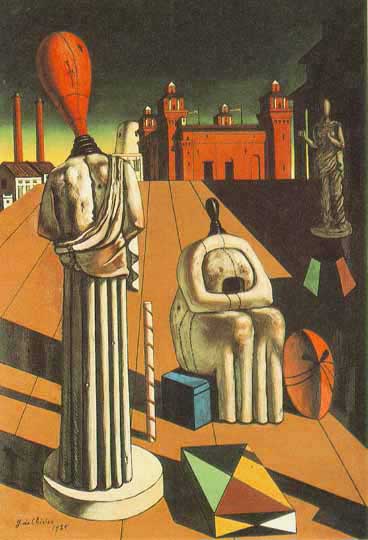
Metaphysical painting (Italian: pittura metafisica), also known as metaphysical art, emerged as a distinct artistic style developed by Italian painters Giorgio de Chirico and Carlo Carrà. The movement originated in 1910 with de Chirico, whose evocative, dreamlike compositions frequently featured stark contrasts of light and shadow, imparting a subtly menacing and enigmatic quality, characterized as "painting that which cannot be seen." De Chirico, his younger brother Alberto Savinio, and Carrà formally established the school and its foundational principles in 1917.
Development
Unlike many of his contemporaries, Giorgio de Chirico found minimal inspiration in the works of Cézanne and other French modernists. Instead, he drew significant influence from the paintings of Swiss Symbolist Arnold Böcklin and German artists such as Max Klinger. His painting The Enigma of an Autumn Afternoon (c. 1910) is widely recognized as his inaugural Metaphysical work, stemming from what de Chirico described as a "revelation" experienced in Florence's Piazza Santa Croce. Subsequent works by de Chirico featured unsettling depictions of deserted squares, often framed by steeply receding arcades illuminated by raking light. Distant, diminutive figures cast elongated shadows, or in their stead, featureless dressmakers' mannequins populate the scenes, collectively evoking a profound sense of temporal and spatial disorientation.
In 1913, Guillaume Apollinaire first employed the term "metaphysical" to characterize de Chirico's distinctive paintings.
In February 1917, Futurist painter Carlo Carrà encountered de Chirico in Ferrara, where both were stationed during World War I. Carrà subsequently developed a variation of the Metaphysical style, replacing the dynamism characteristic of his earlier work with a profound sense of immobility. The two artists collaborated for several months in 1917 at a military hospital in Ferrara. According to art historian Jennifer Mundy, "Carrà adopted de Chirico's imagery of mannequins set in claustrophobic spaces, but his works lacked de Chirico's sense of irony and enigma, and he always retained a correct perspective." Following an exhibition of Carrà's work in Milan in December 1917, critics began to credit Carrà as the originator of Metaphysical painting, much to de Chirico's displeasure. Carrà did little to refute this perception in his 1919 book, Pittura Metafisica, leading to the dissolution of the artists' relationship. By 1919, both artists had largely abandoned the style, shifting their focus to Neoclassicism.
Other artists who adopted this style included Giorgio Morandi, active approximately between 1917 and 1920, Filippo de Pisis, and Mario Sironi. Throughout the 1920s and beyond, the enduring legacy of Metaphysical painting influenced the oeuvres of Felice Casorati, Max Ernst, and others. Exhibitions of Metaphysical art held in Germany in 1921 and 1924 notably inspired the incorporation of mannequin imagery in works by George Grosz and Oskar Schlemmer. Furthermore, numerous paintings by René Magritte, Salvador Dalí, and other Surrealists integrated formal and thematic elements derived from Metaphysical painting.
During the interwar period in Italy, numerous architectural manifestations of the metaphysical poetics of the "Piazza d'Italia" emerged, whose timeless atmosphere appeared conducive to the propaganda requirements of the era. Squares imbued with a metaphysical character were constructed in historic city centers, such as Brescia or Varese, and in newly established cities like those of the Agro Pontino (Sabaudia, Aprilia), culminating in the spectacular, albeit unfinished, EUR district in Rome.
References
Giorgio de Chirico: The Spirits Released : De Chirico and Metaphysical Perspective
- Giorgio de Chirico: The Spirits Released : De Chirico and Metaphysical Perspective