
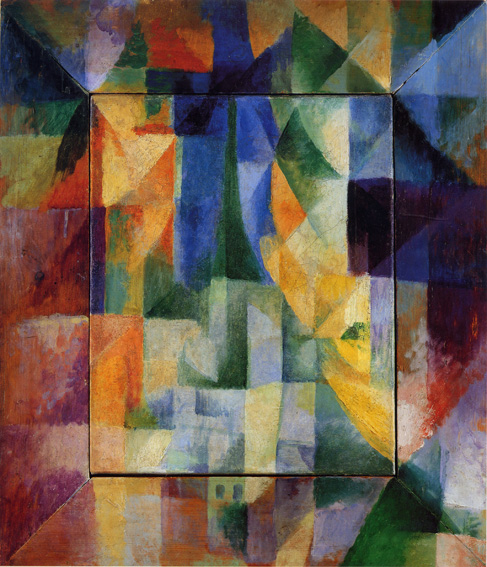
Orphism, also known as Orphic Cubism, emerged in 1912 as a distinct branch of Cubism, a designation attributed to the French poet Guillaume Apollinaire. This artistic movement emphasized pure abstraction and vibrant chromatic palettes, drawing influence from Fauvism and the theoretical contributions of Paul Signac, Charles Henry, and the dye chemist Michel Eugène Chevreul. Recognized as pivotal in the evolution from Cubism to Abstract art, Orphism was spearheaded by František Kupka, Robert Delaunay, and Sonia Delaunay, who notably revitalized the application of color during Cubism's predominantly monochromatic period.
Orphist artworks meticulously examine color and the interplay of light. This artistic style flourished in the early 1910s, a period marked by technological advancements that reshaped perceptions of time and space. Practitioners of Orphism delved into the transformative potential inherent in color, form, and movement. Notable artists who adopted the Orphist approach include Marcel Duchamp, Mainie Jellett, Francis Picabia, Amadeo de Souza-Cardoso, Stanton Macdonald-Wright, and Morgan Russell.
History
While originating from Cubism, Orphist artists gravitated towards a distinct lyrical abstraction. They conceptualized art as the synthesis of sensory experience and chromatic expression. Prioritizing sensation, these artists initially rendered discernible subjects using abstract structural frameworks. Ultimately, Orphism sought to transcend identifiable subject matter through an exclusive focus on form and color. Furthermore, the movement aspired to embody the principles of Simultanism, characterized by perpetually interconnected states of existence.
The Neo-Impressionist color theory, particularly concerning the decomposition of spectral light as articulated by Paul Signac and Charles Henry, significantly contributed to the emergence of Orphism. Charles Henry, a polymath encompassing roles as a mathematician, inventor, and aesthetician, maintained personal relationships with prominent figures such as Robert Delaunay, Albert Gleizes, and Gino Severini. He was also a close associate of Symbolist writers Félix Fénéon and Gustave Kahn, and acquainted with Seurat, Signac, and Pissarro, having encountered them at the eighth and final Impressionist exhibition in 1886. Henry introduced emotional associational theory into artistic discourse, a concept that profoundly influenced the Neo-Impressionists. Both Henry and Seurat posited that the fundamental constituents of art—line, color, and form—could function akin to linguistic elements, possessing independent abstract qualities, or be integrated harmoniously, contingent upon the artist's intent. Fénéon observed in 1889 that "Seurat recognizes that the line, beyond its topographical function, holds a quantifiable abstract value," complementing the chromatic particles and their emotional resonance for the observer. This foundational Neo-Impressionist theory exerted a sustained impact on Delaunay's oeuvre. While Neo-Impressionists successfully established a scientific framework for color in painting, primarily concerning the light spectrum (with less scientific rigor for paint pigments), Cubists subsequently adapted aspects of this theory to inform their use of color, form, and dynamics.
Apollinaire
In 1912, during an address at the Salon de la Section d'Or, Apollinaire introduced the term Orphism, specifically in reference to František Kupka's practice of pure painting.
Within his 1913 publication, Les Peintres Cubistes, Méditations Esthétiques, Apollinaire characterized Orphism as "the art of painting new totalities with elements that the artist does not take from visual reality, but creates entirely by himself." He further asserted that an Orphic painting ought to "convey an 'untroubled aesthetic pleasure', a meaningful structure and sublime significance."
Such conceptual parallels were evident in the oeuvres of František Kupka and Wassily Kandinsky. Both artists endeavored to synthesize scientific principles within visual and auditory domains, thereby expanding the scope of abstraction. Robert Delaunay and Sonia Delaunay, for instance, depicted electric light and posited that luminosity could emanate directly from a painted surface.
Exhibitions
The Salon de la Section d'Or in 1912 marked the inaugural public presentation of Orphism. Subsequently, in March 1913, Orphist works were showcased at the Salon des Indépendants in Paris. In his review of this salon published in Montjoie on March 29, 1913, Apollinaire advocated for the supersession of Cubism by Orphism, proclaiming: "If Cubism is dead, long live Cubism. The kingdom of Orpheus is at hand!"
The 1913 Autumn Salon (Erster Deutscher Herbstsalon, Berlin), curated by Herwarth Walden of Der Sturm, featured numerous works by Robert and Sonia Delaunay, Jean Metzinger's L'Oiseau bleu (1913, Musée d'Art Moderne de la Ville de Paris), Albert Gleizes' Les Joueurs de football (1912-1913, National Gallery of Art), paintings by Picabia and Léger, alongside several Futurist pieces. Following this exhibition, Apollinaire's relationship with R. Delaunay deteriorated after discussions with Umberto Boccioni regarding the ambiguous nature of 'simultaneity'. Consequently, Apollinaire ceased employing the term Orphism in his later publications, instead advocating for the works of Picabia, Alexander Archipenko, and Futurist principles.
The Delaunays
Robert Delaunay and his wife, Sonia Terk Delaunay, were central figures in the Orphist movement. Their initial artistic endeavors explored Fauvist color palettes, often in abstract forms. Examples include Sonia's 1907 Finnish Girl, which utilized pure colors, and Robert's 1906 Paysage au disque, characterized by color and mosaic-like brushstrokes. The latter work was created under the influence of Jean Metzinger, who was then a Neo-Impressionist incorporating strong Divisionist and Fauve elements.
In 1912, Delaunay formally disassociated himself from Cubism, criticizing Picasso for limiting the color spectrum of his still lifes to subdued, monochromatic shades of brown and gray, and for preserving remnants of figurative representation.
Although Orphism largely dissipated prior to World War I, two of R. Delaunay's American pupils, Patrick Henry Bruce and Arthur Burdett Frost Jr., pursued a comparable artistic style beginning in 1912. Concurrently, Synchromist artists Morgan Russell and Stanton Macdonald-Wright authored distinct manifestos, seeking to distinguish their movement from the Orphism practiced by the Delaunays.
Purism
- Purism
- De Stijl
- Crystal Cubism
- Orpheus (play)
References and Sources
- References
- Sources
- Baron, Stanley, and Jacques Damase. Sonia Delaunay: The Life of an Artist. Harry N. Abrams, Inc., 1995.
- Buckberrough, Sherry A. Robert Delaunay: The Discovery of Simultaneity. Ann Arbor, Michigan: UMI Research Press, 1978.
- Chadwick, Whitney, and Isabelle de Courtivron (eds.). Significant Others: Creativity and Intimate Partnership. London: Thames & Hudson, 1993.
- Chip, Herschel B. "Orphism and Color Theory." The Art Bulletin, vol. 40, no. 1, March 1958, pp. 55–63.
- Damase, Jacque. Sonia Delaunay: Rhythms and Colours. Greenwich, Connecticut: New York Graphic Society Ltd, 1972.
- Gale, Matthew. Dada and Surrealism. New York: Phaidon Press Inc., 2006.
- Hughes, Gordon. "Envisioning Abstraction: The Simultaneity of Robert Delaunay's First Disk." The Art Bulletin, vol. 89, no. 2, June 2007, pp. 306–332. The College Art Association.
- Museum of Modern Art (MoMA). Orphism.
- Seidner, David. "Sonia Delaunay." BOMB Magazine, no. 2 (Winter 1982): ART.
- Stangoes, Nikos (ed.). Concepts of Modern Art: Fauvism to Post-Modernism. Chapter: "Orphism," by Virginia Spate. Revised edition. London: Thames & Hudson, 1981.
- MoMA Collection: Robert Delaunay
- MoMA Collection: František Kupka
- Harmony and Dissonance: Orphism in Paris, 1910–1930 Exhibition at Solomon R. Guggenheim Museum, November 8, 2024–March 9, 2025. Catalog