
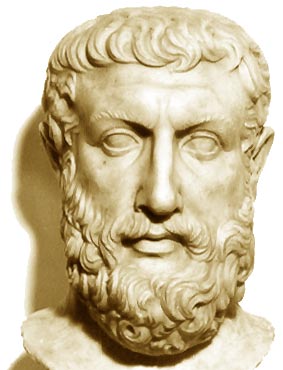
The Eleatics constituted a pre-Socratic philosophical school in the 5th century BC, originating from the ancient Greek colony of Elea (Ancient Greek: Ἐλέα), which was situated approximately 80 miles southeast of Naples in southern Italy, a region then referred to as Magna Graecia.
Key figures associated with Eleatic doctrines include Parmenides, Zeno of Elea, and Melissus of Samos, while other Italian philosophers, such as Xenophanes of Colophon and Empedocles, have occasionally been categorized within this intellectual current. Traditionally, the Eleatics are understood to have championed a rigorous metaphysical monism, posited as a counterpoint to the materialist monism advanced by their predecessors, the Ionian school.
History
According to Patricia Curd, establishing the chronology of pre-Socratic philosophers remains a highly debated topic within the field. Modern scholarship often regards many historical accounts provided by Plato, Diogenes Laertius, or Apollodorus as having limited evidentiary weight. Furthermore, verifiable exact dates are scarce, compelling most chronological estimations and relative sequencing to depend on interpretations of internal evidence from extant fragments.
A general consensus places Parmenides in the early 5th century BC, a dating derived from the fictionalized setting of Plato's Parmenides, which depicts Parmenides and Zeno engaging in a debate with a young Socrates in Athens. This chronology positions Parmenides significantly later than figures like Xenophanes, Heraclitus, and Pythagoras. While numerous historical interpretations have posited Eleatic doctrines as responses to Xenophanes, Heraclitus, or Pythagoras, no widespread scholarly agreement or direct evidence supports such influence or direct engagement, despite various theories proposing interpretations of the Eleatics through the lens of these earlier thinkers. However, for philosophers succeeding Parmenides, establishing relative chronology and potential vectors of influence proves even more challenging.
Regarding Zeno, the reciprocal influence between his ideas and those of Anaxagoras or Empedocles remains uncertain, despite their approximate contemporaneity. The question of influence becomes even more intricate for Melissus, who lived a generation later, due to potential interactions with Leucippus, Democritus, and Diogenes of Apollonia. For instance, some scholars propose that Melissus responded to Leucippus' atomism, which subsequently prompted a response from Democritus; conversely, other interpretations suggest Melissus directly addressed Democritus's ideas.
Philosophy
The One
The Eleatics posited the fundamental unity of the cosmos, asserting that "All is One." Parmenides substantiated this perspective by contending that all existence either "is" or "is not." Given that "is not" lacks genuine existence, it follows that only "what is" can truly subsist, thereby encompassing all phenomena within this singular category. In his didactic poem, On Nature, Parmenides articulated:
Come now, I will tell thee—and do thou hearken to my saying and carry it away—the only two ways of search that can be thought of. The first, namely, that It is, and that it is impossible for it not to be, is the way of belief, for truth is its companion. The other, namely, that It is not, and that it must needs not be,—that, I tell thee, is a path that none can learn of at all. For thou canst not know what is not —that is impossible—nor utter it; for it is the same thing that can be thought and that can be.
Melissus of Samos further developed this concept, becoming one of the first philosophers to champion the principle that nothing can originate from nothing, and that a primordial cause was essential for the universe's existence. He contended that this primordial cause, designated "The One," must be both eternal and infinite. Its infinitude, he argued, precludes division into parts, as such fragmentation would necessitate the establishment of finite boundaries among those constituents. Consequently, being inherently whole, The One is immutable, incapable of undergoing any alteration.
Motion
Given the Eleatic premise that The One is immutable, they consequently denied the possibility of motion. They posited that all perceived motion constituted sensory illusions, as the senses are inherently incapable of apprehending the universal unity. Accordingly, they prioritized rigorous adherence to reason over empirical evidence.
Creation
The Eleatic school posited that creation is impossible, asserting that existence cannot originate from non-existence, as an entity cannot emerge from something fundamentally distinct from itself. They contended that misunderstandings regarding this principle frequently stem from the equivocal application of the verb 'to be,' which can denote either concrete physical existence or merely function as a linguistic copula linking a subject and its predicate.
Zeno's Paradoxes
Zeno of Elea utilized several reductio ad absurdum paradoxes to challenge the notion of motion, aiming to dismantle opposing arguments by demonstrating that their foundational premises resulted in logical contradictions ( Zeno's paradoxes).
Legacy
In Plato's Sophist, a prominent character is identified as an 'Eleatic stranger,' and Plato further recognized the Eleatics within his dialogues Parmenides and Statesman. Certain scholars propose a connection between Meno's paradox, presented in Plato's dialogue Meno, and the Eleatic differentiation between states of 'knowing' and 'not-knowing.'
References
Sources
- Boyer, Carl B.; Merzbach, Uta C. (2011). A History of Mathematics (Third ed.). Hoboken, New Jersey: John Wiley & Sons. pp. 67–68. ISBN 978-0-470-52548-7.Curd, Patricia (2004). The Legacy of Parmenides: Eleatic Monism and Later Presocratic Thought. Las Vegas, Nevada: Parmenides Publishing. ISBN 1-930972-15-6.Laks, Andre; Most, Glenn W., eds. (2016). "Western Greek Thinkers, Part 2". Loeb Classical Library. Early Greek Philosophy. Vol. 528. Cambridge, Massachusetts: Harvard University Press. ISBN 978-0-674-99706-6.Palmer, John Anderson (2009). Parmenides and Presocratic Philosophy. Oxford: Oxford University Press. ISBN 9780199567904.Chisholm, Hugh, ed. (1911). "Eleatic School". Encyclopædia Britannica. Vol. 9 (11th ed.). Cambridge University Press. pp. 168–169."Eleatic School" . Encyclopædia Britannica. Vol. VIII (9th ed.). 1878. p. 1.
- "Eleatic School" . Encyclopædia Britannica. Vol. VIII (9th ed.). 1878. p. 1.Zalta, Edward N., ed. "Parmenides". Stanford Encyclopedia of Philosophy. ISSN 1095-5054. OCLC 429049174.Zalta, Edward N., ed. "Zeno of Elea". Stanford Encyclopedia of Philosophy. ISSN 1095-5054. OCLC 429049174.Zalta, Edward N., ed. "Zeno's Paradoxes". Stanford Encyclopedia of Philosophy. ISSN 1095-5054. OCLC 429049174.Zalta, Edward N., ed. "Xenophanes". Stanford Encyclopedia of Philosophy. ISSN 1095-5054. OCLC 429049174.Zalta, Edward N., ed. "Monism". Stanford Encyclopedia of Philosophy. ISSN 1095-5054. OCLC 429049174.
- "On Nature" by Parmenides, translated by John Burnet
- Fragments of Melissus at Wikisource
- "Eleatic School" . Encyclopædia Britannica. Vol. VIII (9th ed.). 1878. p. 1.Zalta, Edward N., ed. "Parmenides". Stanford Encyclopedia of Philosophy. ISSN 1095-5054. OCLC 429049174.Zalta, Edward N., ed. "Zeno of Elea". Stanford Encyclopedia of Philosophy. ISSN 1095-5054. OCLC 429049174.Zalta, Edward N., ed. "Zeno's Paradoxes". Stanford Encyclopedia of Philosophy. ISSN 1095-5054. OCLC 429049174.Zalta, Edward N., ed. "Xenophanes". Stanford Encyclopedia of Philosophy. ISSN 1095-5054. OCLC 429049174.Zalta, Edward N., ed. "Monism". Stanford Encyclopedia of Philosophy. ISSN 1095-5054. OCLC 429049174.